Important Dates in Free and Open Source Software History
This page lists the first release dates and anniversary dates of widely used free and open source software projects — GNU/Linux distributions, desktop environments, databases, programming languages, browsers, and tools. Use it as a quick reference to find out when your favourite open source project was born, or to discover which FOSS anniversaries fall this month.
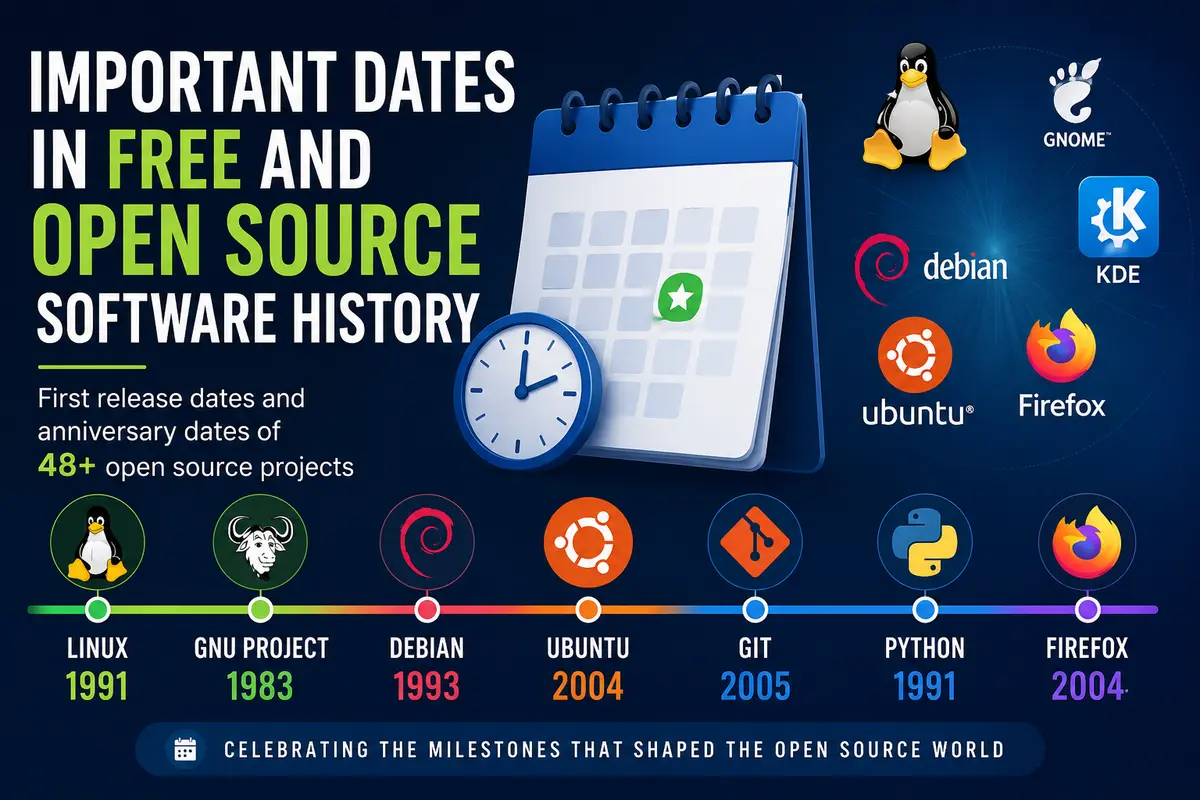
Dates are sourced from official project histories and verified release records. The Anniversary Date column shows the calendar date used to mark the project's birthday each year. The First Release Date column shows the full date of the first public release or the officially recognised project birthday. The table is sorted by anniversary date. See also our desktop environment reference pages and the open source distribution index for more background on individual projects.
Open Source Software — First Release Dates
| # | Software / Distribution | Anniversary Date | First Release Date | Brief History |
|---|---|---|---|---|
| January | ||||
| 1 | Blender | 2nd January | 1994-01-02 | Blender is a powerful open source 3D creation suite used for animated films, visual effects, and games. It was created by Ton Roosendaal at Dutch studio NeoGeo; January 2, 1994 is its official birthday based on the earliest source file timestamps. It became free and open source software in October 2002 following a community fundraiser. |
| 2 | OpenWrt | 15th January | 2004-01-15 | OpenWrt is a Linux-based OS for embedded devices, primarily used on home and enterprise routers. It replaces vendor firmware with a fully writable file system and package manager, giving users control over their hardware. |
| 3 | MediaWiki | 25th January | 2002-01-25 | MediaWiki is the wiki software that powers Wikipedia and thousands of other wikis. It was written by Magnus Manske and first deployed on the English Wikipedia on January 25, 2002. The name "MediaWiki" was adopted in August 2003. Development is now coordinated by the Wikimedia Foundation. |
| 4 | LibreOffice | 25th January | 2011-01-25 | LibreOffice is a free office suite forked from OpenOffice.org by The Document Foundation. Its first release appeared on January 25, 2011. It supports open document formats and is the default office suite in many Linux distributions. |
| February | ||||
| 5 | VLC media player | 1st February | 2001-02-01 | VLC is a free, open source media player and streaming server developed by VideoLAN. It plays most audio and video formats without requiring additional codecs. VLC was originally a student project at École Centrale Paris and was released as open source in February 2001. |
| 6 | Python | 20th February | 1991-02-20 | Python is a widely used general-purpose programming language created by Guido van Rossum. Version 0.9.0 was released on February 20, 1991. Python emphasises readable code and has become the language of choice for data science, machine learning, and scripting. |
| 7 | ReactOS | 24th February | 1998-02-24 | ReactOS is an open source operating system designed to be binary-compatible with Windows applications and drivers. The project started in February 1998 with the goal of providing a free alternative to Windows. |
| March | ||||
| 8 | GNOME | 3rd March | 1999-03-03 | GNOME (GNU Network Object Model Environment) is a widely used desktop environment for Linux and Unix-like systems. It was founded in 1997 by Miguel de Icaza and Federico Mena as a fully free alternative to KDE. GNOME 1.0 was released on March 3, 1999 at the LinuxWorld Conference in San Jose, California. It is now maintained by the GNOME Foundation and ships as the default desktop in Fedora, Ubuntu, and Red Hat Enterprise Linux. |
| 9 | Ansible | 9th March | 2012-03-09 | Ansible is an open source IT automation platform. It uses an agentless, SSH-based architecture and plain YAML playbooks, making it straightforward to deploy and manage infrastructure. Red Hat acquired Ansible in 2015. |
| 10 | Arch Linux | 11th March | 2002-03-11 | Arch Linux is a rolling release distribution aimed at experienced users who prefer a minimal, custom-built system. It follows a "keep it simple" philosophy and is maintained through a community-driven package manager called Pacman. |
| 11 | Kali Linux | 13th March | 2013-03-13 | Kali Linux is a Debian-based distribution built for penetration testing and security auditing. It is developed and maintained by Offensive Security and ships with hundreds of security tools pre-installed. |
| 12 | Docker | 20th March | 2013-03-20 | Docker is an open source platform for building, shipping, and running applications inside software containers. It standardises how applications are packaged and deployed across different environments. |
| 13 | SUSE Linux | 29th March | 1994-03-29 | SUSE Linux is one of the oldest commercial Linux distributions, originally released in Germany in 1994. It is known for its enterprise support and the YaST system configuration tool. SUSE later spawned the community-driven openSUSE project. |
| 14 | Xfce | 30th March | 1997-02-18 | Xfce is a lightweight desktop environment for Unix-like operating systems. It is designed to be fast and low on system resources while remaining visually appealing. Development began in late 1996; the first public release is recorded in early 1997. Xfce uses GTK as its toolkit. |
| 15 | elementary OS | 31st March | 2011-03-31 | elementary OS is a Linux distribution focused on design and ease of use. It ships with the Pantheon desktop environment and targets users who want a clean, polished interface. It is built on an Ubuntu LTS base. |
| April | ||||
| 16 | Git | 7th April | 2005-04-07 | Git is a distributed version control system created by Linus Torvalds to manage Linux kernel development. The first release appeared on April 7, 2005. Git is now the dominant version control system in the software industry and underpins platforms such as GitHub and GitLab. |
| 17 | NetBSD | 20th April | 1993-04-20 | NetBSD is a Unix-like operating system known for its portability across a wide range of hardware platforms, from embedded systems to enterprise servers. The NetBSD Foundation maintains the project under a BSD licence. |
| May | ||||
| 18 | MySQL | 23rd May | 1995-05-23 | MySQL is one of the world's most widely used open source relational databases. It was created by Michael Widenius and David Axmark and first released in May 1995. Sun Microsystems acquired MySQL AB in 2008; Oracle later acquired Sun in 2010. MySQL remains widely deployed in LAMP stacks worldwide. |
| June | ||||
| No entries for June yet — suggest one below. | ||||
| July | ||||
| 19 | Zorin OS | 1st July | 2009-07-01 | Zorin OS is a Linux distribution designed to ease the transition from Windows and macOS. It provides a familiar desktop layout and ships with a range of pre-installed software to reduce setup time for new Linux users. |
| 20 | Wine | 4th July | 1993-07-04 | Wine is a compatibility layer that allows Windows applications to run on Linux, macOS, and other Unix-like systems without a Windows licence. Development started in 1993 and the project is co-ordinated by the WineHQ community. |
| 21 | PostgreSQL | 8th July | 1996-07-08 | PostgreSQL is a powerful open source object-relational database system with more than 35 years of active development. It supports ACID transactions, JSON, full-text search, and a rich extension ecosystem. Version 1.0 was released in July 1996. |
| 22 | Slackware | 17th July | 1993-07-17 | Slackware, created by Patrick Volkerding, is one of the oldest surviving Linux distributions. It was first released on July 17, 1993 and is known for its simplicity, stability, and close adherence to Unix conventions. |
| 23 | Gentoo Linux | 26th July | 2000-07-26 | Gentoo Linux is a source-based distribution that compiles packages from source using the Portage package manager. Users can tune compilation flags for their hardware, giving fine-grained control over performance and features. It was created by Daniel Robbins. |
| August | ||||
| 24 | QEMU | 15th August | 2003-08-15 | QEMU is an open source machine emulator and virtualiser. It can emulate a wide range of CPU architectures and is used as the backbone of many virtualisation stacks, including KVM on Linux. Fabrice Bellard created QEMU in 2003. |
| 25 | Haiku | 18th August | 2001-08-18 | Haiku is an open source operating system inspired by BeOS, with a focus on personal computing and multimedia performance. Development as "OpenBeOS" started in August 2001; the project was renamed Haiku in 2004. Haiku R1 Beta 1 arrived in 2018. |
| 26 | Linux kernel | 25th August | 1991-08-25 | On August 25, 1991, Linus Torvalds posted a message to the comp.os.minix newsgroup announcing a "free operating system (just a hobby)" he was developing. The first public release, version 0.01, followed in September 1991. The Linux kernel is now the most widely deployed operating system kernel in the world. |
| September | ||||
| 27 | FreeDOS | 3rd September | 1994-09-03 | FreeDOS is an open source, MS-DOS-compatible operating system started by Jim Hall in 1994. It is used to run legacy software, flash BIOS firmware, and as a lightweight environment for embedded systems. |
| 28 | Debian | 15th September | 1993-09-15 | Debian is one of the oldest and most influential Linux distributions. Ian Murdock announced the project on August 16, 1993; the first release (0.01) appeared on September 15, 1993. Debian is the upstream base for Ubuntu, Linux Mint, Kali Linux, and hundreds of other distributions. |
| 29 | Firefox | 23rd September | 2002-09-23 | Firefox's first public release — named Phoenix 0.1 — appeared on September 23, 2002. The browser was later renamed Firebird, then Firefox. Firefox 1.0 was released on November 9, 2004. It is developed by the Mozilla Foundation and is known for its focus on privacy and open web standards. |
| 30 | GNU Project | 27th September | 1983-09-27 | Richard Stallman announced the GNU Project on September 27, 1983, with the goal of creating a fully free Unix-like operating system. GNU tools — including GCC, Bash, and GNU Coreutils — form the userland of most Linux-based systems today. |
| October | ||||
| 31 | Nginx | 4th October | 2004-10-04 | Nginx is a high-performance web server, reverse proxy, and load balancer. Igor Sysoev began development in 2002 and released Nginx publicly on October 4, 2004. It is one of the most widely deployed web servers on the internet. |
| 32 | OpenOffice.org | 13th October | 2000-10-13 | OpenOffice.org was an open source office suite derived from StarOffice, which Sun Microsystems acquired in 1999. Sun announced the project on July 19, 2000, and the source code went live on October 13, 2000. OpenOffice.org 1.0 was released on May 1, 2002. It was later donated to the Apache Software Foundation (Apache OpenOffice) and also forked as LibreOffice. |
| 33 | Lubuntu | 13th October | 2011-10-13 | Lubuntu is a lightweight Ubuntu-based distribution that uses the LXQt desktop environment. It is designed for older hardware with limited resources and ships as an official Ubuntu flavour. |
| 34 | KDE * | 14th October | 1996-10-14 | KDE is a free software community that develops the KDE Plasma desktop environment and a wide range of applications. The project was announced on October 14, 1996 by Matthias Ettrich — the date the KDE community celebrates as its official anniversary. KDE 1.0, the first stable release, arrived on July 12, 1998. |
| 35 | OpenBSD | 18th October | 1996-10-18 | OpenBSD is a Unix-like operating system forked from NetBSD by Theo de Raadt in 1995. Version 2.0 — the first release under the OpenBSD name — appeared on October 18, 1996. It is known for its strong security defaults and proactive auditing of the codebase. |
| 36 | Ubuntu | 20th October | 2004-10-20 | Ubuntu is a popular Debian-based Linux distribution developed by Canonical. Its first release (4.10, "Warty Warthog") appeared on October 20, 2004. Ubuntu is widely used on desktops, servers, and cloud infrastructure, and serves as the base for many derivative distributions. |
| 37 | Void Linux | 20th October | 2008-10-20 | Void Linux is an independent, rolling release distribution that uses the XBPS package manager and runit init system. It is one of the few mainstream distributions that does not use systemd. |
| 38 | PCLinuxOS | 24th October | 2003-10-24 | PCLinuxOS is a rolling release Linux distribution derived from Mandriva (formerly Mandrake). It is known for being easy to set up and use out of the box, particularly for desktop users transitioning from Windows. |
| 39 | MariaDB | 29th October | 2009-10-29 | MariaDB is a community-developed fork of MySQL, created in 2009 by MySQL founder Monty Widenius after Oracle acquired Sun Microsystems. It is a drop-in replacement for MySQL and is the default database in many Linux distributions. |
| November | ||||
| 40 | FreeBSD | 1st November | 1993-11-01 | FreeBSD is a Unix-like operating system derived from the BSD Unix research releases at the University of California, Berkeley. Version 1.0 was released on November 1, 1993. It is known for its advanced networking stack, ZFS support, and jails virtualisation. |
| 41 | Vim | 2nd November | 1991-11-02 | Vim (Vi IMproved) is a highly configurable text editor built for efficient text editing. Bram Moolenaar released version 1.14 on November 2, 1991. It extends the classic vi editor with scripting, plugins, and syntax highlighting. Vim remains popular among developers and system administrators. |
| 42 | Inkscape | 2nd November | 2003-11-02 | Inkscape is a free, open source vector graphics editor that uses SVG as its native file format. It started as a fork of Sodipodi in 2003 and has grown into a professional-grade illustration tool used by designers worldwide. |
| 43 | Red Hat Linux | 3rd November | 1994-11-03 | Red Hat Linux was one of the most influential early Linux distributions. It introduced the RPM package format and formed the basis for what became Red Hat Enterprise Linux (RHEL) and the community-supported Fedora project. |
| 44 | Fedora | 6th November | 2003-11-06 | Fedora is a community-driven Linux distribution sponsored by Red Hat. It ships with cutting-edge software and acts as the upstream testing ground for RHEL. Fedora Core 1, the first release, appeared on November 6, 2003. |
| 45 | MPlayer | 11th November | 2000-11-11 | MPlayer is a free and open source media player that supports a wide range of audio and video formats. It can be used as a command-line tool or with graphical front-ends such as SMPlayer. Development began in Hungary in 2000. |
| 46 | GIMP | 21st November | 1995-11-21 | GIMP (GNU Image Manipulation Program) is a free, open source raster graphics editor. Spencer Kimball and Peter Mattis released the first public version in November 1995 at the University of California, Berkeley. GIMP is used for photo retouching, image composition, and graphic design. |
| December | ||||
| 47 | Apache HTTP Server | 1st December | 1995-12-01 | The Apache HTTP Server is a free and open source web server maintained by the Apache Software Foundation. It traces its roots to the NCSA HTTPd server and was first released in December 1995. For many years it was the most widely used web server on the internet. |
| 48 | Perl | 18th December | 1987-12-18 | Perl is a high-level programming language created by Larry Wall. Version 1.000 was released on December 18, 1987. Perl was widely used for system administration, web development (CGI), and text processing, and remains active today under the stewardship of The Perl Foundation. |
Notes: KDE — the anniversary is traditionally celebrated on October 14 (the 1996 announcement date); KDE 1.0, the first stable release, arrived on July 12, 1998. The table uses October 14 as the anniversary date to match community convention. Blender — the first release date (1994-01-02) reflects the earliest source file timestamp recognised as Blender's official birthday; the software became publicly available as freeware on January 1, 1998. OpenOffice.org — the anniversary date reflects the source code release (October 13, 2000) rather than the announcement date. Firefox — the date (2002-09-23) marks Phoenix 0.1, the first public version of the project that would be renamed Firefox. Xfce — development began in late 1996; the first confirmed public release is from early 1997. March 30 is used as the anniversary date following community convention.
Missing a project? This list covers 48 projects and grows with community input. If you know the verified first release date of a FOSS project not listed here, leave a comment below and we will review it for inclusion. Please include a source link where possible.
Frequently Asked Questions
- When was the Linux kernel first released?
- Linus Torvalds announced the Linux kernel on August 25, 1991, in a post to the comp.os.minix newsgroup. The first public release (version 0.01) followed in September 1991.
- When was Debian first released?
- Debian's first release (version 0.01) appeared on September 15, 1993. Ian Murdock announced the project on August 16, 1993.
- When was Ubuntu first released?
- Ubuntu's first release (4.10, "Warty Warthog") appeared on October 20, 2004. It is developed by Canonical and is based on Debian.
- When was Python first released?
- Python version 0.9.0 was released on February 20, 1991 by Guido van Rossum.
- When was Git created?
- Git was created by Linus Torvalds and first released on April 7, 2005, to manage Linux kernel development.