Reproducible texture optimization for cocoa whipped cream
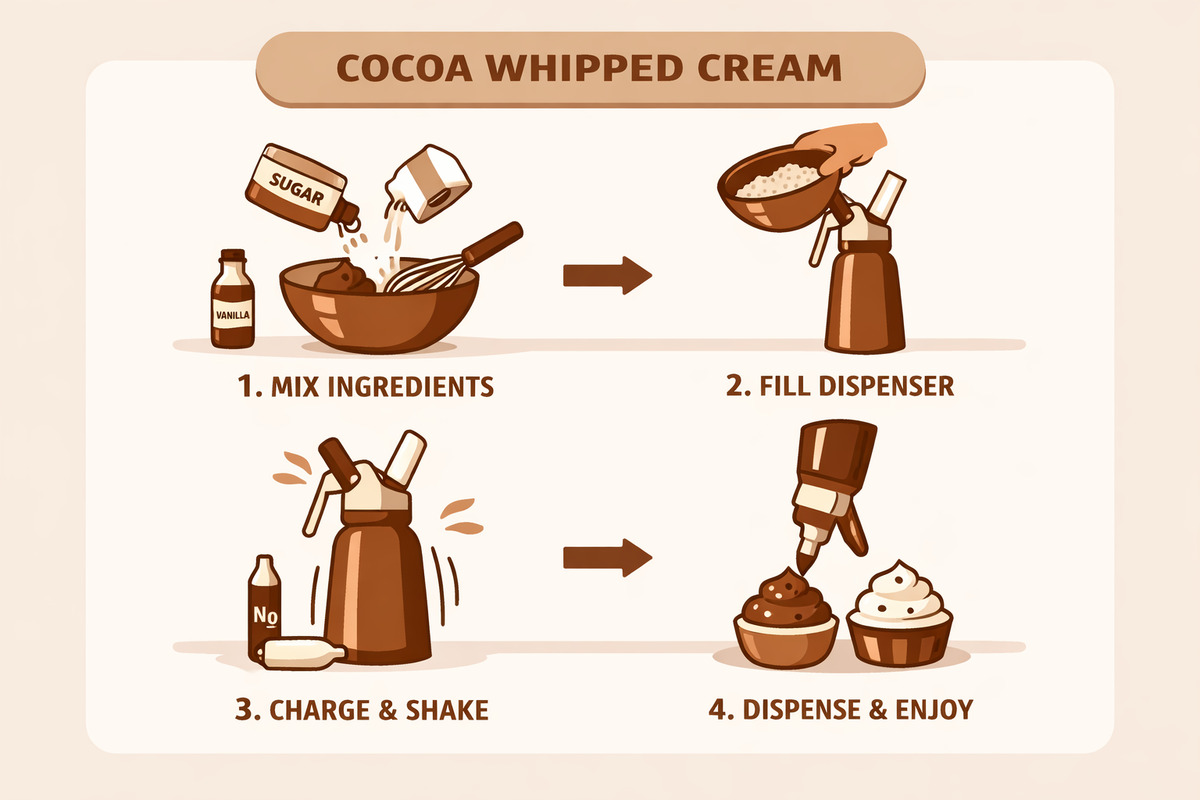
Whipped cream dispensers have evolved beyond simple kitchen tools into precision instruments. Within the Exotic Whip Germany community — the focus is particularly on consistent pressure and texture control. These systems enable a uniform emulsion, which is especially important for cocoa-based mixtures, as cocoa can affect the stability of the fat structure.
Technical Challenges in Cocoa Whipped Cream
Cocoa whipped cream is not a trivial “build.” The integration of cocoa particles significantly alters the physical properties of the mixture.
Typical issues:
- Unstable air structure due to solid particles
- Clumping caused by uneven mixing
- Excessive compaction at incorrect temperatures
- Loss of volume stability over time
These problems can be reduced through structured process control, similar to bug fixing in an open-source project.
Comparison: Standard Whipped Cream vs. Cocoa Whipped Cream
| Property | Standard Whipped Cream | Cocoa Whipped Cream |
|---|---|---|
| Stability | High | Medium |
| Mixing Complexity | Low | High |
| Error Susceptibility | Low | Increased |
| Temperature Sensitivity | Medium | High |
| Flavor Variability | Low | High |
These differences show that cocoa whipped cream requires more “engineering effort” than the classic version.
Process Pipeline for Stable Cocoa Whipped Cream
To achieve consistent results, the process can be broken down into clearly defined steps:
1. Base Preparation The cream must be fully chilled to maintain fat structure stability. Any deviation leads to inconsistencies later on.
2. Cocoa Integration Cocoa should be finely sifted and evenly incorporated to avoid cluster formation.
3. Structure Formation Controlled air integration stabilizes the mixture. This step determines the final texture.
4. Stabilization The mixture must be processed or stabilized immediately to prevent collapse of the air structure.
Automation and Modern Kitchen Systems
Modern gastronomy increasingly relies on automated systems to reduce human error. These systems function similarly to CI/CD pipelines in software development.
Advantages:
- Reproducible results across multiple cycles
- Reduced error rates in complex recipes
- Faster production times
- Scalability for larger quantities
This type of process automation is particularly relevant for sensitive recipes like cocoa whipped cream.
Factors Influencing Final Texture
| Factor | Impact on Texture | Optimization Strategy |
|---|---|---|
| Temperature | Very high | Maintain constant cooling |
| Cocoa quality | High | Use finely sifted cocoa |
| Mixing intensity | Medium to high | Controlled integration |
| Air incorporation | Very high | Even distribution |
These factors act like variables in a configuration file that determines the final output.
Stability as a Design Goal
In the open-source context, stability is not accidental but the result of clean architecture. The same applies to cocoa whipped cream: the better the process is structured, the more reliable the final result.
The combination of precise temperature control, even cocoa distribution, and stable air integration leads to a reproducible culinary “release” that remains consistent across iterations.