Data Center Decommissioning: When the Cloud Hits the Ground
Modern society depends on processes it never sees and rarely thinks about.
We scroll through social media feeds, stream our favorite shows on Netflix, and order food on apps, expecting everything to just work. As it usually does, we ignore the complex machinery behind it.
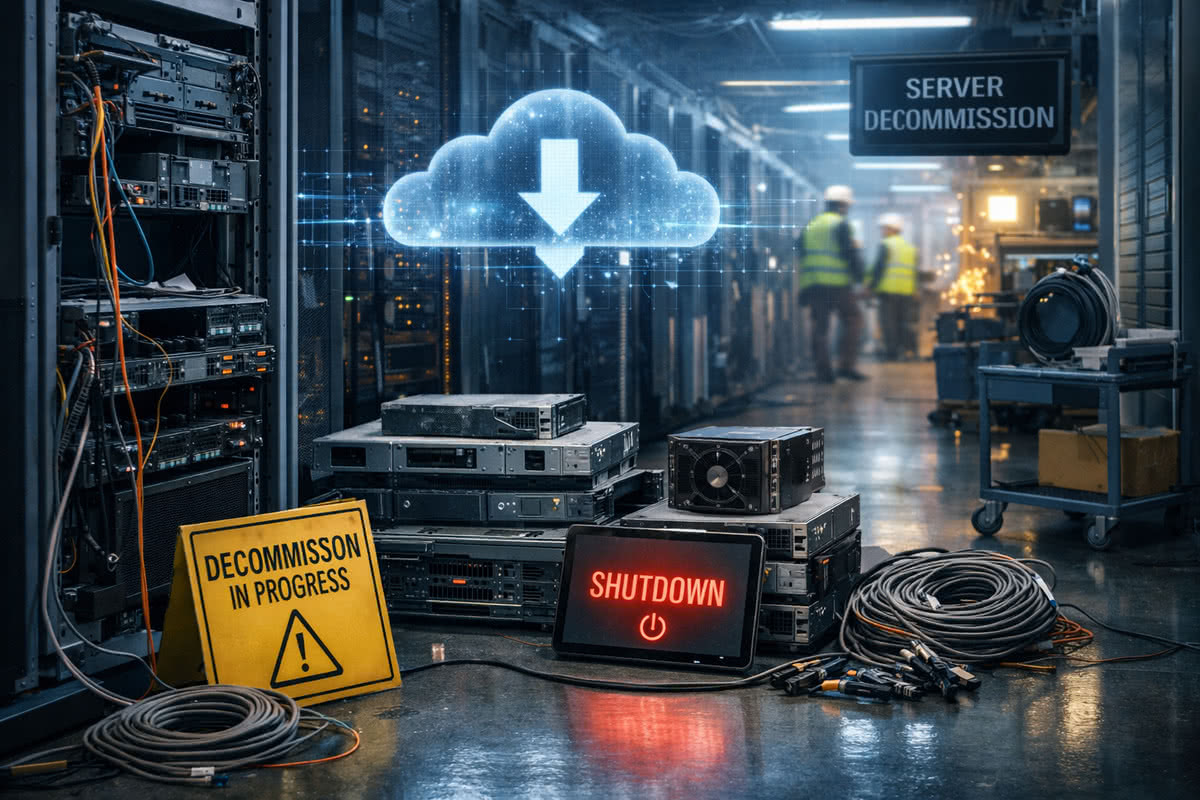
Yet beneath every click or tap lies a physical foundation: hardware that powers the internet and eventually wears out.
We talk about “the cloud” and “wireless” as if data floats freely, unbound by place or matter. But every email, video, and transaction relies on tangible buildings: data centers packed with servers, power equipment, cooling systems, and endless cables. These places are not only built, but also retired when their time is up.
So what happens when a data center reaches the end? Welcome to the world of
data center decommissioning, the fascinating process of shutting down (and repurposing) the internet’s physical backbone.
What a Data Center Actually Is
Strip away the jargon, and a data center is an industrial-scale environment designed to keep computers running nonstop.
Inside, rows of server racks work tirelessly day and night. Power is supplied from multiple grids and backup generators, while advanced cooling systems prevent overheating. Every detail is engineered for maximum reliability.
These facilities aren’t static. As hardware, technology, and business needs shift, entire data centers can become outdated. What once made sense financially or technically may, at some point, become inefficient. When that happens, shutting a facility down becomes a project of its own.
Infrastructure Doesn’t Disappear When It’s Obsolete
It’s easy to think that digital infrastructures must be disposed of when they’re no longer needed. We change our phones every couple of years and move on. Why not assume the same applies to data centers?
The reality is, outdated centers don’t vanish into the cloud. They remain physically present, storing sensitive data, and consuming energy. As such, they pose both risks and opportunities for value recovery.
A single decommissioned data center can contain thousands of servers, miles of copper and fiber cabling, and tons of battery systems. Simply “turning it off” isn’t an option; instead, data must be securely erased, equipment carefully disconnected, and all assets thoroughly tracked.
If handled carelessly, decommissioning could result in data breaches, regulatory violations, environmental hazards, or major financial losses. Unlike old-fashioned, wrecking-ball demolition, it’s a highly controlled disassembly process with high stakes.
What Decommissioning Really Involves
At its core, data center decommissioning is about safely unwinding an intricate system.
The process starts long before the first server is unplugged. Teams inventory all equipment, map out dependencies, and carefully schedule shutdowns to avoid premature disruptions.
Keeping data secure is essential: all storage devices must be thoroughly wiped or destroyed, and records must be kept to prove each step was handled properly.
Only then does physical labor begin: powering down systems, removing servers, extracting cabling, dismantling racks, and managing power infrastructure.
Much of the equipment retains value; servers and components can be refurbished and reused elsewhere, extending hardware lifecycles and minimizing waste.
Often, the end of one facility marks the beginning of another.
A Sustainable Process?
Decommissioning also involves an often-overlooked aspect of internet sustainability. Data centers demand significant resources to build, and discarding their contents prematurely results in unnecessary waste and expense.
Effective decommissioning prioritizes reuse. Refurbished hardware gets a second life in smaller data centers or enterprises. At the same time, materials that can’t be reused are recycled, while hazardous components are properly disposed of, so that they don’t end up in landfills.
In this sense, decommissioning counterbalances the fast pace of technological change. It acknowledges that while innovation moves fast, infrastructure deserves thoughtful closure.
Why This Work Stays Invisible
Most people never see a data center, let alone one being decommissioned. That invisibility is partly intentional: the smoother the process, the less disruption for users. Websites remain online, services run uninterrupted, and there’s no need for a public countdown or dramatic shutdown ceremonies.
That quiet competence is by design. Decommissioning is successful when it feels uneventful, with massive logistical, technical, and security challenges resolved seamlessly.
Behind the scenes, however, it’s meticulous, physical work carried out by teams who understand the ins and outs of IT systems and industrial environments.
The End Is Just Another Phase
The internet seems immortal, but its infrastructure is anything but permanent.
Data centers age, business strategies change, and technology moves on: that’s well known in an era of constant innovation. What matters is not avoiding these endings, but handling them responsibly.
Data center decommissioning is living proof that the digital world has a lifecycle like any other built system: a beginning, a productive middle, and a carefully managed end, which in itself may be the birth of another digital facility.
So the next time a video loads instantly or a file syncs seamlessly, remember: behind that ease is a physical world that must be built, maintained, and, when its time ends, thoughtfully deconstructed.