From X-Rays to EHRs: A Practical Guide to Medical Data Annotation Services
Ask most people what “data annotation” means in healthcare and they’ll picture someone drawing boxes around tumors on a scan. That’s part of it. But medical data annotation services cover a surprisingly wide spectrum of tasks — each with its own requirements, its own annotator skill profile, and its own failure modes when done carelessly.
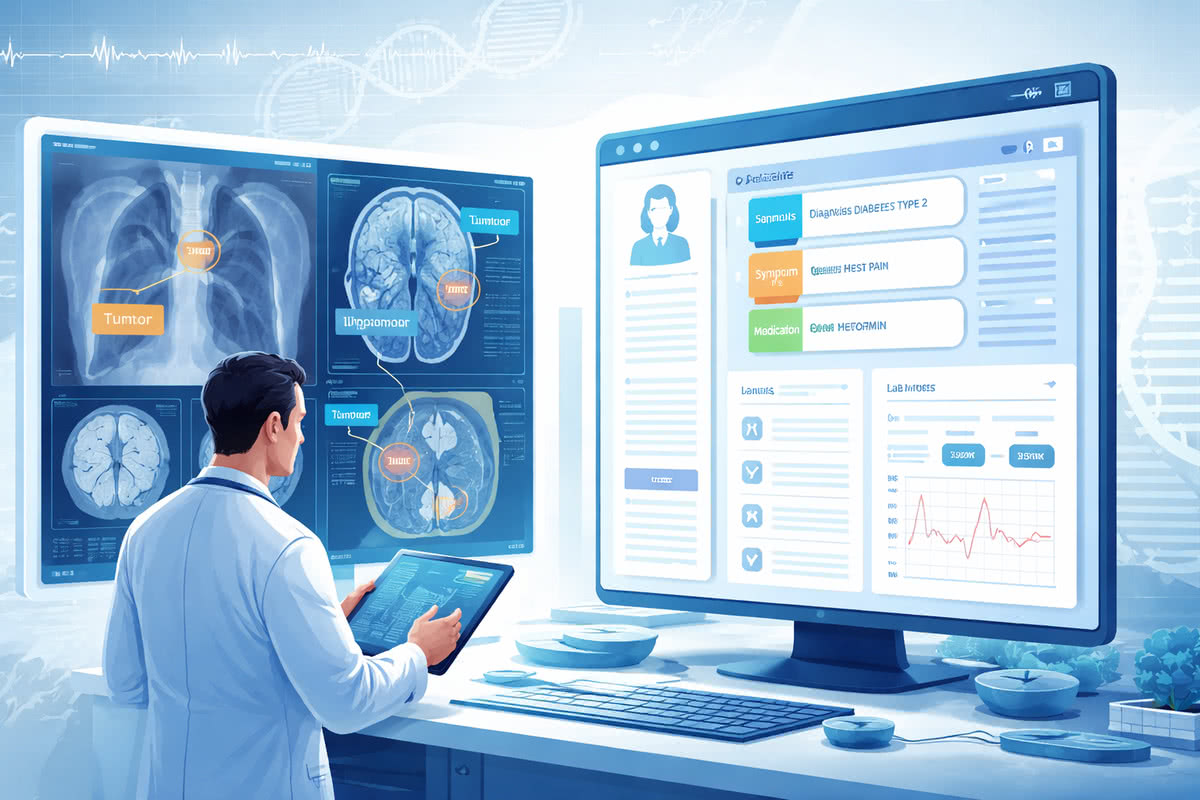
If you’re building any kind of AI-assisted healthcare tool and trying to understand what annotation actually involves, this is the breakdown you probably wish someone had handed you at the start of the project.
Medical Imaging: The Most Visible Category
Radiology is where most people’s mental model of medical annotation begins, and for good reason — it’s the highest-volume use case and the one with the most mature tooling around it.
At its core, medical image annotation involves marking clinically relevant structures in visual data so a model can learn to recognize them. But what that looks like in practice varies enormously depending on the imaging modality and the clinical task.
Bounding boxes are the simplest form — a rectangle drawn around a lesion, nodule, or anatomical landmark. They’re fast to produce and adequate for detection tasks where precise boundaries don’t matter. Finding a potential mass in a chest X-ray, for example, may only require a rough localization rather than exact segmentation.
Semantic segmentation goes further. Here, annotators label every pixel in an image — delineating the exact boundary of a tumor, organ, or tissue type. This is computationally demanding to annotate and produces significantly richer training signal for the model. It’s the standard approach for surgical planning tools, organ volume measurement, and pathology analysis where morphology matters.
Landmark annotation involves marking specific anatomical points — the tip of a vertebra, the center of a joint, the edge of a cardiac chamber. This is common in orthopedics, cardiology, and dental imaging, where precise spatial measurements drive downstream clinical decisions.
Each of these requires annotators who understand what they’re looking at. An annotator who can accurately place bounding boxes around cells in a histopathology slide is doing something fundamentally different from someone labeling objects in street photography — the domain knowledge requirement is incomparable.
Clinical NLP: The Underestimated Category
Medical imaging gets most of the attention, but clinical natural language processing is arguably a more complex annotation challenge — and one with enormous practical applications.
Electronic health records are a goldmine of clinical information trapped in unstructured text. Physician notes, discharge summaries, radiology reports, pathology findings — these contain detailed, nuanced clinical data that structured fields in an EHR simply don’t capture. Teaching a model to extract, classify, and reason about that data requires annotated training examples, and annotating them is genuinely hard.
Named entity recognition in clinical text means labeling mentions of diagnoses, symptoms, medications, dosages, procedures, and anatomical references. The challenge is that medical language is abbreviated, inconsistent, and highly context-dependent. “HTN” means hypertension. “SOB” means shortness of breath. A model that doesn’t understand these conventions — and more importantly, a human annotator who doesn’t — produces training data full of gaps and errors.
Relation extraction takes it further: not just identifying that a medication is mentioned, but linking it to the condition it treats, the dosage administered, and the patient response. This level of annotation requires genuine clinical literacy, not just pattern-matching ability.
Sentiment and assertion classification matters more than people expect. The same diagnosis mentioned in a note can carry very different meanings depending on whether it’s being asserted, negated, or hypothesized. “No evidence of pneumonia” and “pneumonia confirmed” are opposite clinical facts — and a model trained on annotations that conflate them will produce unreliable outputs.
Genomic and Biosignal Data: The Emerging Frontier
Beyond imaging and text, annotation is increasingly needed for signal data — ECGs, EEGs, continuous glucose monitoring streams, wearable sensor data — and for genomic datasets where variants need to be classified by clinical significance.
ECG annotation, for instance, involves labeling arrhythmias, waveform morphologies, and interval measurements across time-series data. The ground truth here often requires cardiologist review, and inter-annotator agreement on subtle findings can be surprisingly low — which is exactly why building adjudication processes into the annotation workflow matters.
Genomic annotation is a different beast entirely. Classifying variants as pathogenic, benign, or of uncertain significance requires annotators with training in molecular biology or clinical genetics, access to current variant databases, and a clear framework for handling evidence that doesn’t point cleanly in one direction.
The Operational Realities That Determine Quality
Across all of these annotation types, the factors that separate reliable annotation from unreliable annotation are largely the same.
Annotator qualification has to match the task. This sounds obvious but is routinely ignored in practice. General-purpose data labeling platforms can handle commodity annotation tasks at low cost. Medical annotation is not a commodity task. The annotator reviewing a histopathology slide or labeling a clinical note should have domain-relevant training — full stop.
Annotation guidelines need to handle ambiguity explicitly. Every medical annotation project encounters cases where the right label isn’t clear. A guideline that doesn’t address those edge cases produces inconsistent training data as different annotators resolve ambiguity differently. Building consensus on ambiguous cases upfront, and documenting those decisions, is what separates professional annotation operations from informal ones.
This is where providers like Mindy Support differentiate themselves — through structured workflows that include specialist annotator teams, documented QA processes, and explicit handling of inter-annotator disagreement rather than averaging it away.
Compliance infrastructure is non-negotiable for any project involving real patient data. HIPAA in the US, GDPR in Europe, and various national health data regulations all impose specific requirements on how patient data is accessed, processed, stored, and transferred during annotation. A provider that can’t clearly articulate their compliance posture for the relevant regulatory frameworks is not a provider you want touching your clinical datasets.
Choosing the Right Service for the Right Task
Not every annotation task requires the same level of clinical expertise, and part of working efficiently with annotation providers is being clear about where that bar actually sits.
A project to label clearly defined anatomical structures in high-contrast imaging might be approachable for well-trained non-clinician annotators following precise guidelines. A project to classify variant pathogenicity in genomic data requires experts. Being honest about those distinctions — rather than defaulting to either “we need MDs for everything” or “any labeler can handle this” — produces better outcomes at better economics.
The common thread across all of it is that medical annotation is specialized work that produces training data for systems that affect patient care. That framing should inform every resourcing decision you make.