



Advertisement
Overview
Nextcloud is an open source, self-hosted content collaboration platform that lets individuals and organizations store, sync, and share files, calendars, contacts, and communications on servers they control. The project was forked from ownCloud in 2016 by Frank Karlitschek, ownCloud’s original founder, along with most of ownCloud’s core developers, following disagreements over the direction and governance of ownCloud Inc., the company behind that project. The fork was announced in June 2016, and the Nextcloud server codebase is licensed under the GNU Affero General Public License (AGPLv3 or any later version), a copyleft license chosen specifically to ensure that modifications to the software, including those run as a network service, remain open source.
Since the fork, Nextcloud has grown into a widely deployed platform used by government agencies, enterprises, educational institutions, and individual users, with the project reporting hundreds of thousands of active deployments worldwide. Development is coordinated by Nextcloud GmbH, a German company, alongside a broader open source community, and the software is distributed both as a self-hosted package for personal servers and through third-party hosting providers. Nextcloud Hub bundles the core file storage and sync functionality with a growing set of first-party applications, positioning the platform as an on-premises alternative to services like Dropbox, Google Workspace, and Microsoft 365.
Key Features
- File sync and share — Sync files across desktop (Linux, Windows, macOS), mobile (Android, iOS), and web clients, with fine-grained sharing permissions and link sharing
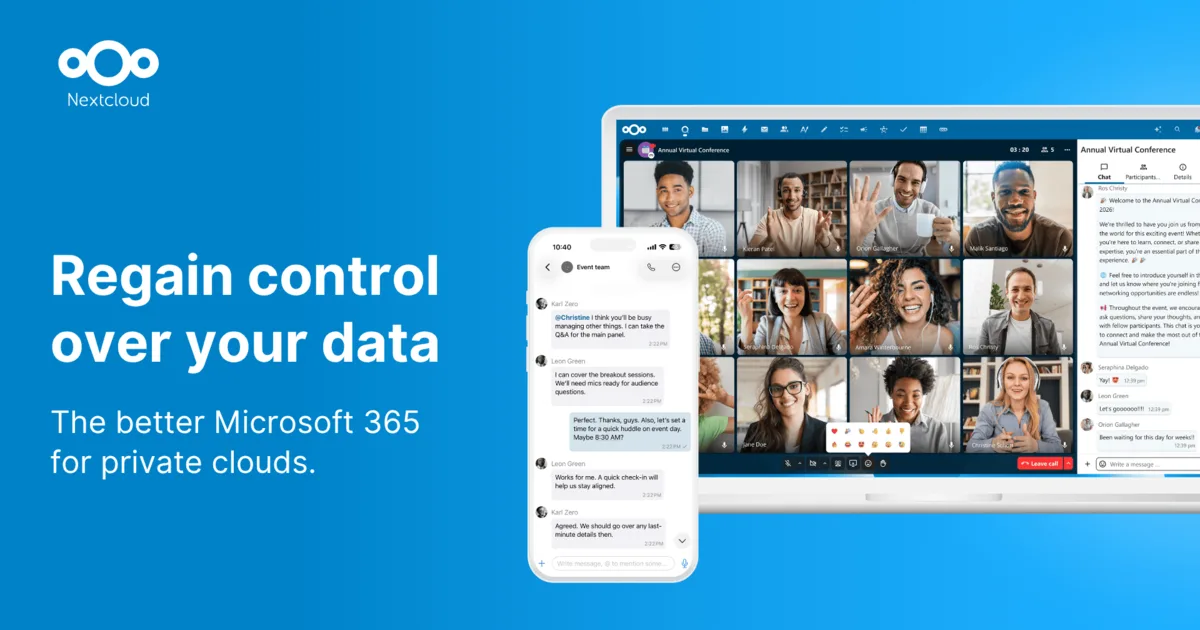
- Talk — On-premises audio and video conferencing, text chat, and screen sharing
- Calendar and Contacts — CalDAV/CardDAV-based groupware for scheduling and address books, syncing with standard calendar and contacts apps
- Office/Collabora integration — In-browser document editing via Collabora Online or OnlyOffice, supporting collaborative editing of common office file formats
- Encryption and 2FA — Server-side encryption and two-factor authentication for account security
- App ecosystem — Hundreds of community and first-party apps extending functionality, including workflow automation (Flow) and AI-assisted features (Assistant)
- Federation — Server-to-server sharing between independent Nextcloud instances
Use Cases
- Individuals and families — Private, self-hosted alternative to consumer cloud storage services
- Small and medium businesses — File collaboration and groupware without recurring per-seat subscription costs
- Government and public sector — Data sovereignty requirements met by hosting files on infrastructure the organization controls
- Educational institutions — Shared storage and communication tools for staff and students
- Managed service providers — White-label cloud storage offerings built on Nextcloud
Who It’s For
Nextcloud is suited to organizations and individuals who want control over where their data is stored, whether for privacy, compliance, or cost reasons, and who have the technical resources (or a hosting provider) to run and maintain a server. It is commonly used by system administrators, privacy-conscious users, and institutions subject to data residency requirements.
Advertisement