Building a Stronger Revenue Cycle for Healthcare Providers
A healthcare organization can deliver excellent care and still struggle financially if the process behind collecting for that care isn’t solid. Money moves through a lot of steps between a patient visit and a paid claim, and any weak point along that path can quietly drain revenue the organization already earned. That’s why strengthening this process matters so much for financial stability, keeping patient services running without interruption, and building operations that can actually sustain themselves over time. Services like https://pharmbills.com/revenue-cycle-management-services-for-healthcare exist specifically to help providers close those gaps before they turn into bigger problems down the line.
Why revenue cycle weaknesses affect the whole organization
Weaknesses in this process rarely stay contained to the billing department. Billing delays slow down cash flow directly, which can ripple into decisions about staffing or equipment purchases elsewhere in the organization. Denials that pile up unresolved represent revenue the practice has essentially written off, even though the service was already delivered. A growing AR backlog means money that should have arrived months ago is still sitting uncollected. And documentation gaps, where clinical notes don’t fully support what’s billed, generate denials that could have been avoided with better process discipline upfront.
It’s worth noting how quickly these effects show up once a weakness takes hold in the process. A backlog that starts small in January can look completely different by June if nothing changes, since unresolved claims tend to accumulate rather than resolve themselves on their own. That’s part of why catching weaknesses early matters so much — the same fix costs a lot less time and effort when applied to a handful of claims than when applied retroactively to months of accumulated backlog that’s already spread across the whole organization. A little vigilance early on saves a lot of cleanup later.
These weaknesses tend to compound the longer they sit unaddressed. Cash flow problems make it harder to invest in staff training or new equipment, which can indirectly affect the quality of patient service over time. Staff spend more hours chasing old claims and less time handling new work efficiently. And the trust patients place in a provider can erode too, since billing confusion and unexpected balances tend to color how people remember their overall experience, regardless of how good the actual care was. That kind of reputational cost is hard to measure but very real, and it tends to linger long after the underlying billing issue has actually been resolved.
Core components of a strong healthcare revenue cycle
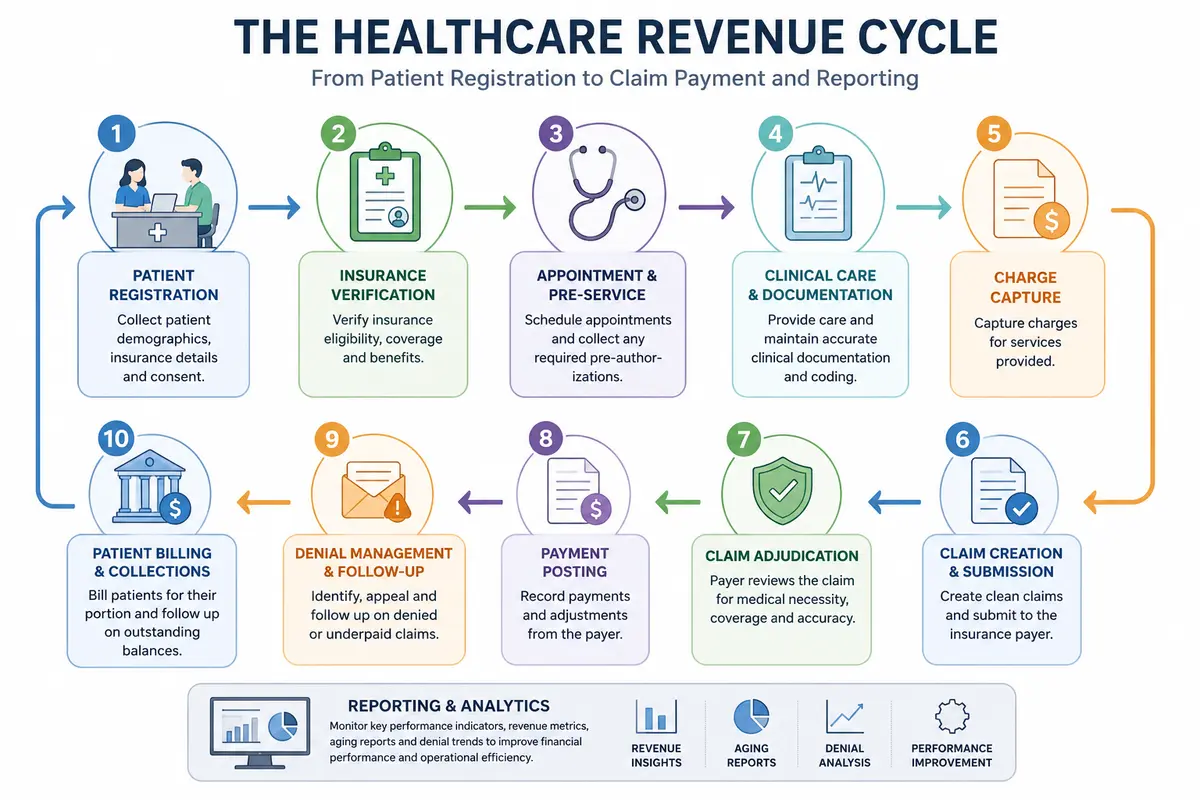
A strong revenue cycle covers a fairly specific set of stages, each one feeding into the next. The core components include:
- Registration, capturing accurate patient and insurance information upfront
- Eligibility verification to confirm coverage before service is delivered
- Coding that translates clinical documentation into billable procedures
- Claim submission to the correct payer with minimal errors
- Denial follow-up to resolve rejected claims quickly
- Payment posting to keep financial records accurate and current
- Patient billing that’s clear enough to avoid confusion or disputes
- Reporting that shows how each stage is actually performing
Weakness in any single stage tends to surface as a problem somewhere further down the chain.
How healthcare providers can strengthen RCM processes
Strengthening RCM processes doesn’t require a complete overhaul, but it does take deliberate effort. Workflow mapping shows exactly where claims move and where they tend to get stuck. KPI tracking turns performance into something measurable instead of a vague impression that things are probably fine. Denial trend analysis catches recurring patterns instead of treating every rejection as an isolated event. Staff training keeps the team current on payer rules that shift more often than most people expect. And reliable task ownership removes the ambiguity that lets claims slip through unnoticed between people.
The value of external revenue cycle support
External revenue cycle support brings a few specific advantages that are hard to replicate internally on short notice. Added capacity means volume spikes don’t automatically translate into slower claims or missed denial follow-up. Specialized expertise covers payer nuances that take years to build up through direct experience. And consistency comes from teams that handle this work daily across many organizations, rather than staff juggling billing alongside several other responsibilities that pull attention in different directions. Pharmbills works with healthcare organizations looking for exactly this combination.
In practice, external support usually shows up as a fairly specific set of contributions rather than a wholesale takeover. It handles the repetitive, high-volume tasks — claim submission, denial follow-up, payment posting — that consume the most staff hours relative to their complexity. It brings reporting discipline that internal teams often don’t have bandwidth to maintain consistently. And it gives leadership a second set of eyes on the process, someone who can flag patterns that internal staff, buried in day-to-day work, might not have time to notice on their own until the numbers are already showing a real problem.
Final thoughts
A stronger revenue cycle ultimately comes down to financial control, fewer preventable losses, and an operation built to last rather than one constantly patching problems as they surface. Providers who invest in solidifying every stage of this process, whether through internal improvements or outside support, tend to see steadier cash flow and far fewer surprises across the board. That stability is what actually supports long-term growth, since it’s hard to plan for the future when the present keeps generating unpredictable financial gaps that demand constant attention and pull focus away from patients.
Comments
Comments are loaded when you choose to open them, which keeps the page faster and lighter.