Best global HR software for UK companies
You run people operations for a UK business that just committed to hiring in Germany, Spain, and the Netherlands inside one financial year. Your current system holds London headcount well enough, yet it has no answer for a Munich contract, a works council, or three sets of statutory fields you’ve never filed. That gap is why global HR software has become a board-level purchase for scaling UK companies, not an admin line item. The record that holds your people across borders now shapes how fast you grow and how well you brief your leadership team.
The label creates most of the confusion. “Global HR software” covers two purchases that solve opposite problems. One employs people for you in countries where your company has no legal entity, so you can put an engineer on compliant German pay before you register a GmbH. The other holds the core people record and runs daily HR for the entities already under your name, with payroll wired in behind it. A UK people leader under a hiring deadline can buy the first when the job calls for the second.
This comparison sorts eight platforms a UK or multinational company weighs in 2026, with the global core HR systems kept apart from the employer-of-record specialists that keep surfacing beside them. Each entry carries a plain summary, the buyer it suits, and what pricing looks like, so you can fit the platform to the way your workforce is built and where it sits, not to a vendor’s homepage.
The best global HR software for UK and multinational companies at a glance
| Software | What it is | Ideal for | Starting price |
|---|---|---|---|
| HiBob (Bob) | Modern all-in-one global core HR and system of record | UK and multinational teams joining up multi-entity people data | Quote-based, suite-based |
| Rippling | Combined HR, IT, and finance automation | Wiring people, devices, and apps into one workflow | Custom quote per employee |
| ADP | Payroll-first HR at global scale | Pay-heavy operations spanning many countries | Quote-based |
| BambooHR | Straightforward core HRIS for smaller teams | Smaller US-based teams wanting a simple core | From about $10 per employee/month (approx.) |
| Personio | European mid-market core HR | Growth clustered in Germany and the wider EU | Per employee by module tier (quote) |
| Deel | Employer of record and contractor payments | Fast market entry with no local entity | EOR from around $599 per employee/month |
| Remote | Owned-entity EOR and global payroll | Owned-entity control of local employment | EOR from $599 per employee/month when billed annually; $699 monthly. |
| Oyster | Employer of record for distributed hiring | Employing overseas talent without local entities | EOR quote plus deposit |
What global HR software means for a UK buyer
Global HR software is the system that manages employees and contractors across countries from one place. Depending on the product, that spans employee records, onboarding, absence, performance, reporting, and pay. Some of these tools are core HR platforms, also called an HRIS: they hold the workforce your own entities already employ and run your HR processes on top of that. Others are global-payroll or employer-of-record services that carry the legal and payroll mechanics of workers in markets where you have no company. The words on the homepage often look identical, so a UK buyer has to read what each product does rather than what it’s called.
Core HR versus an employer of record
One is a piece of software, the other is a legal employer. Your core HR platform is the software: it manages records, onboarding, absence, performance, and pay for the people your entities employ, and it never signs as anyone’s employer. An employer of record signs. It puts its name on the local contract, runs the payroll, and shoulders the statutory duties in a country where you’ve not registered, while your managers still direct the work. The line blurred because global-payroll platforms bolted on HR features and core HR platforms added international payroll, so plenty of UK teams shortlist one when their real need calls for the other. Settle your requirement first, then read the list.
The UK compliance baseline
For a UK-headquartered company, the local anchor comes before any global feature matters. HMRC-recognised payroll with RTI submissions (FPS and EPS), auto-enrolment pensions, statutory sick and parental pay, and P60 and P45 handling all have to work at home, under GDPR and UK data-protection rules and the day-one rights the Employment Rights Act 2025 phases in, before you extend the same record abroad. A platform that runs native UK payroll and holds employee data to GDPR standards gives you a compliant base to grow from. One that treats UK statutory detail as an afterthought will drain hours your team can’t afford the moment the overseas entities switch on.
The best global HR software for UK and multinational companies
The five platforms below run core HR: they hold the people you employ under your own entities and give you one record to grow on. Bob leads for a scaling UK company because it pairs that modern record with connected local payroll and a UK compliance base.
HiBob
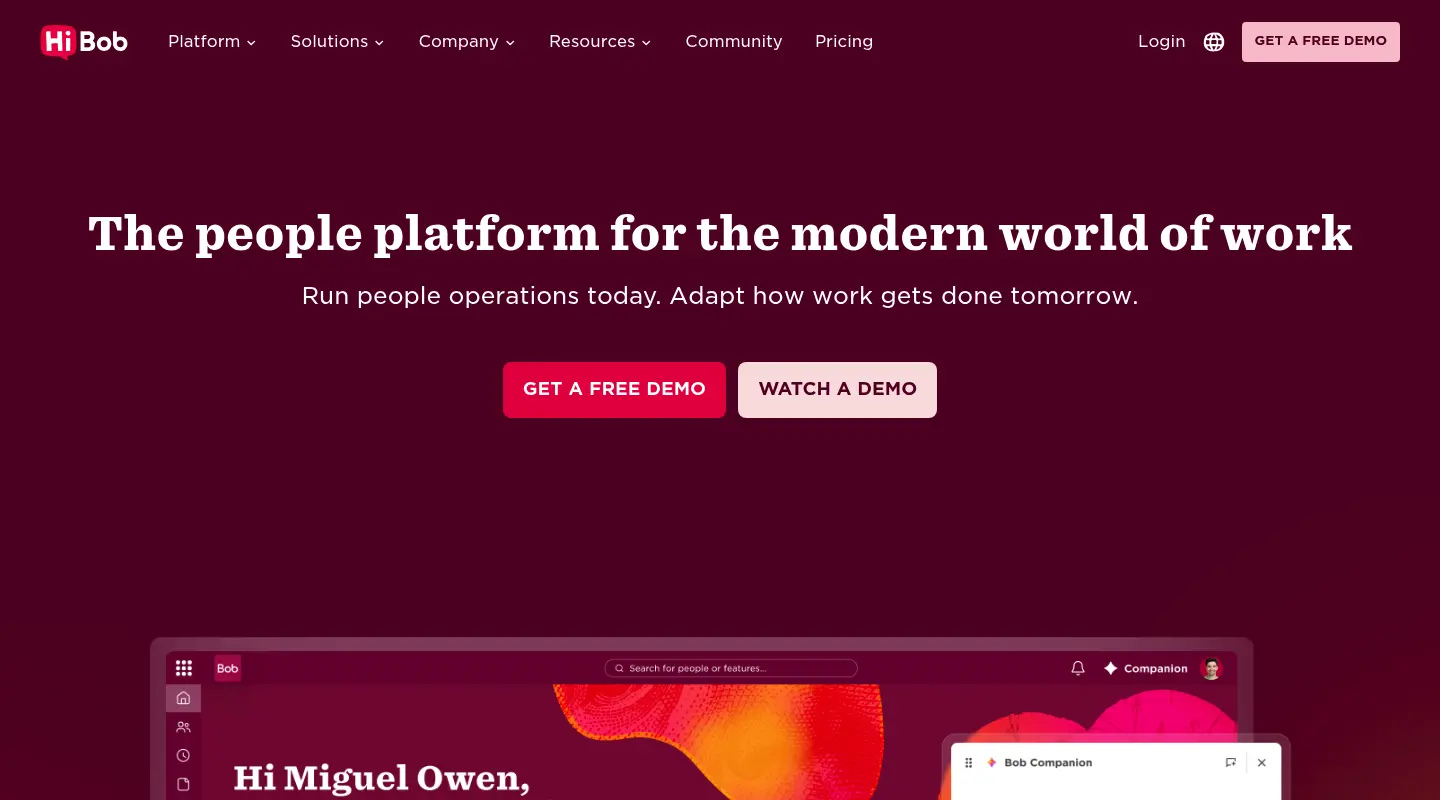
Ideal for: UK and multinational teams that want one modern people record spanning every entity they own.
HiBob built Bob on a premise a scaling UK company recognises: the people data for London, Berlin, and Madrid belongs in one home, governed by one set of rules, read through one lens. The product sits on core HR at the base, so a business operating three or four entities keeps a single employee profile and a single reporting structure for everyone on the books, wherever the contract lives. For a CHRO briefing the board on headcount across countries, that turns a monthly reconciliation into a live figure.
Payroll is the question a global buyer asks next, and Bob handles it without tearing out what already works in each market. The Payroll Hub plugs into the local payroll partners a company runs in each country through no-code setup, then surfaces every run on one dashboard beside the people data, while Bob operates native payroll in the UK and the US. A UK finance lead keeps HMRC-recognised pay at home and compliant local pay abroad, with no separate spreadsheet stitching the two together.
Compliance anchors the rest. Bob holds GDPR-aligned controls, audit-ready process history, and regional workflows, so employee records are governed the way EU regulators and works councils expect as the map fills in. The core platform also carries performance, engagement, hiring, and embedded AI for teams that add them, but the multi-entity record and the connected payroll are what put Bob first on this page. The honest catch: HiBob keeps its pricing off the page. Core is mandatory, and every extra suite lifts the bill, so a UK buyer holding published SME rate cards has to sit through a demo before any figure appears, and Bob prices above the entry-level tools a smaller team might start on.
Feature highlights:
-
One employee record and org structure across every entity, read through a single analytics layer
-
Payroll Hub that links the local providers you already run through no-code setup, with native UK and US payroll
-
GDPR-aligned data controls, audit-ready history, and regional workflows for multi-country compliance
-
Modern, people-first interface that earns daily use from HR, managers, and staff
What it costs: Priced by quote around a suite model. Every customer starts on Core as the foundation and adds Talent, Payroll, or HR Planning on top, so a real number arrives from a demo, not a published rate card.
Rippling
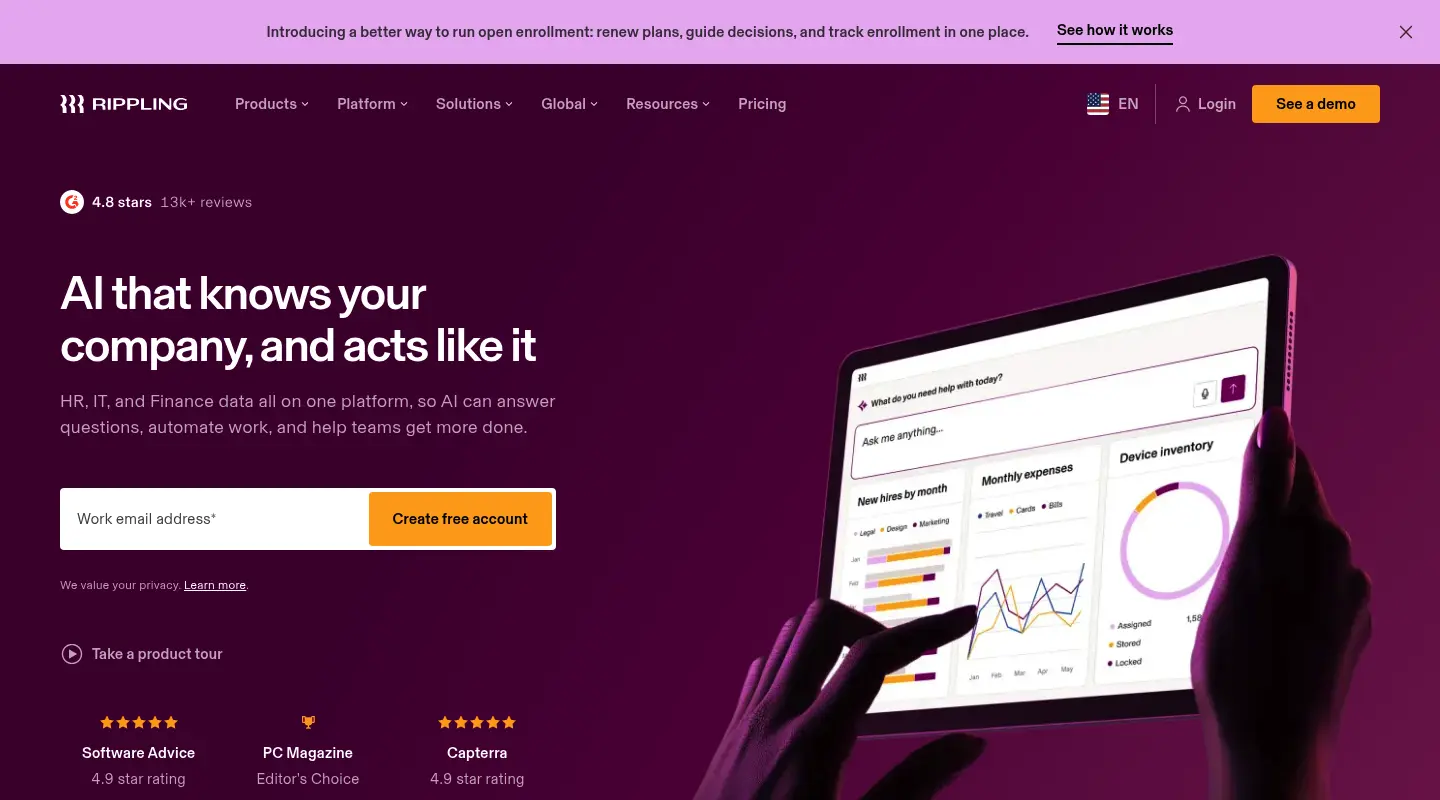
Ideal for: Teams that want HR, IT, and finance driven by one automation engine.
Rippling sells breadth. It ties the employee record to laptops, app access, and payroll, so a single hire action can create the person, hand over their logins, and dispatch a device. A multinational that values automation across departments will see the draw. The catch is how HR feels day to day, since it lives as one module inside a broader operations suite, and the product tilts toward the US, which can leave European entities with less local depth than the home build. Rippling’s G2 mark sits at 4.8 from a base near 12,635 reviews, the biggest on this page, though the steady complaints name gaps in specific features once teams move past the initial rollout and a demanding ramp to get there.
Feature highlights:
-
A single action that sets up the hire, their pay, and their hardware
-
Automation spanning joiner, mover, and leaver events
-
A wide app catalogue for the systems a distributed business runs
What it costs: Priced per module on top of a mandatory core platform fee, delivered as a custom per-employee quote.
ADP
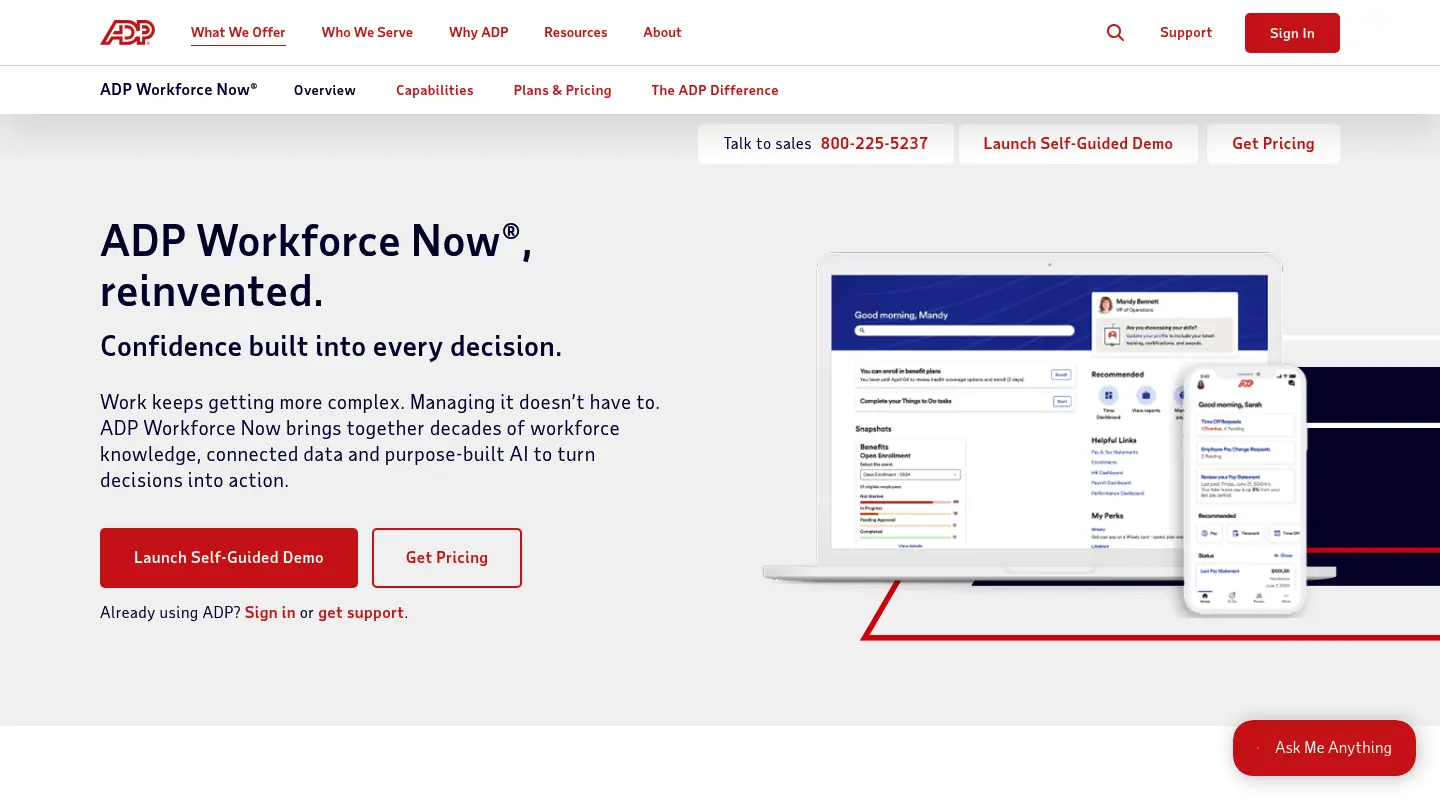
Ideal for: Pay-heavy operations paying staff across many countries under one contract.
Few names carry ADP’s payroll pedigree, and its international services reach genuine scale, paying workers in dozens of countries under a single agreement. A UK or multinational group with several overseas entities can fold a lot of pay complexity into one relationship. Where it gives ground is experience. ADP leads with a pay and compliance engine, so a team hunting for modern culture and engagement tooling won’t find the headline reason to choose it there. On G2 the score reads 4.2 from about 4,209 reviews, and the write-ups return to thin customer support, absent features, and screens that feel dated against fresher suites.
Feature highlights:
-
Payroll and tax filing across many jurisdictions on one agreement
-
Compliance depth tested on very large, multi-entity runs
-
Benefits administration packaged with the pay engine
What it costs: Quote-based, scoped to the services and headcount involved.
BambooHR
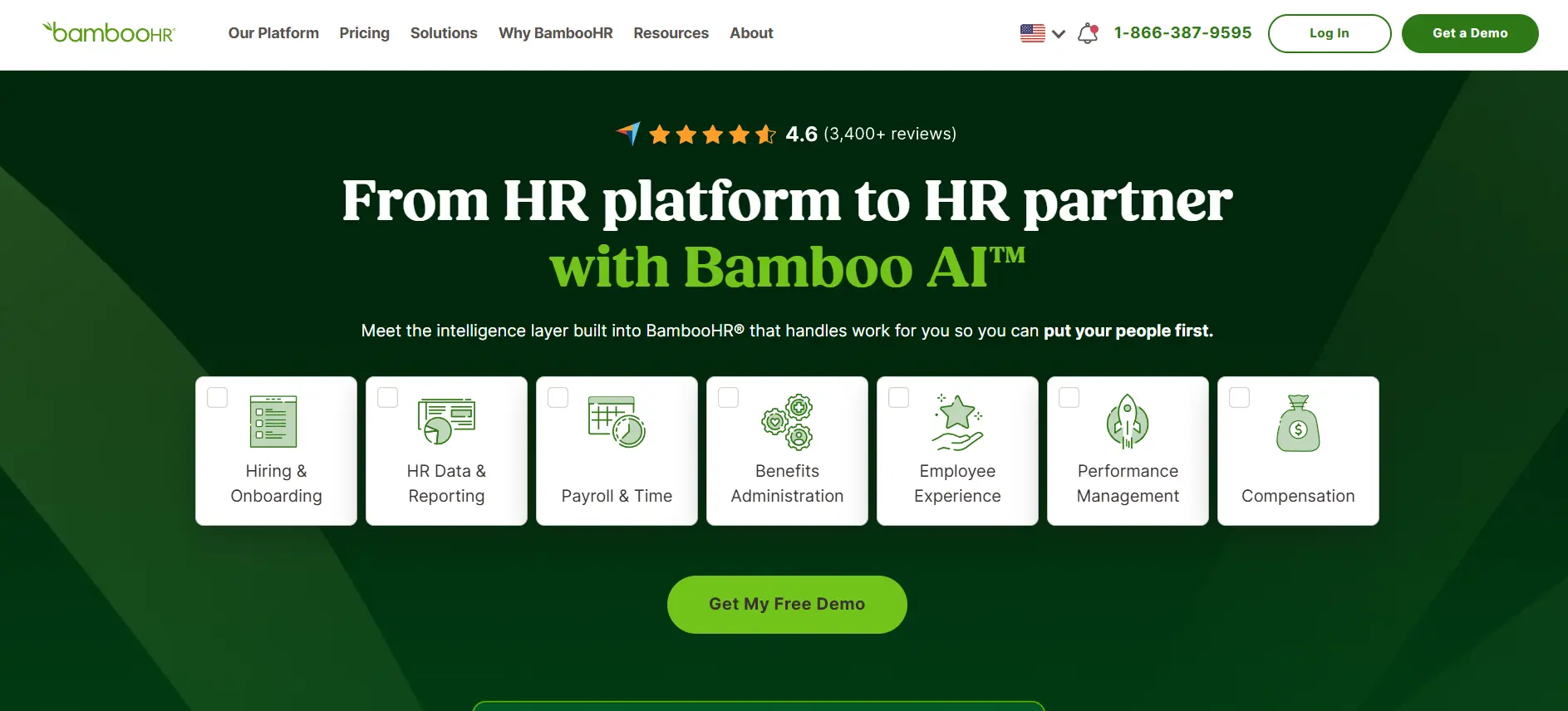
Ideal for: Smaller, US-based teams that want a tidy core HRIS.
BambooHR made its name on friendliness, fast to stand up and painless for a small team to learn, with neat records, absence tracking, and onboarding checklists. A company whose overseas presence stays modest can rest the core on it. Growth and geography are where it runs out of room. Its native pay and benefits cover US employees, so a UK or multinational operation brings in other providers for the rest of the world, and G2 reviewers, who score it 4.4 from about 5,033 reviews, keep raising thin customisation and a hard cap on what the tool does once the work gets involved.
Feature highlights:
-
Quick onboarding with clean records a lean team can manage
-
Self-service for personal details and time off
-
Standard reports built around a US workforce
What it costs: Per employee, with core tiers from around $10 per employee per month for larger teams (approximate; small teams pay a flat monthly floor).
Personio
Ideal for: Companies whose growth clusters in Germany and the wider EU.
Personio grew up inside European HR, and it reads that way, carrying the contract formats and statutory fields that tools born in the US skip past. A UK company whose first move lands in Germany, the Netherlands, or a neighbouring EU market gets a product fluent in local admin. The strain shows away from that home turf and higher up the market, where G2 reviewers, scoring it 4.4 from about 838 reviews, point to absent features and shallow customisation, and its presence dims once you look past its European heartland.
Feature highlights:
-
Localisation with EU-ready contract formats and statutory fields
-
Core HR, absence, and approval routing in one system
-
Automation shaped around local processes
What it costs: Per employee by module tier, with firm figures arriving through a quote.
Where employers of record fit beside global core HR
Search for global HR software and four names dominate the results: Deel, Remote, Oyster, and Papaya Global. Each belongs to a separate category, employer of record and global-payroll specialists, and the distinction is worth stating in plain terms. An EOR becomes the legal employer of a worker in a country where your business has no registered entity, carrying the contract, the payroll, and the statutory duties while your managers set the work. That clears the path into a new market, the very first hire before a company exists on paper. What it doesn’t give you is a master record for the staff your own entities already employ. Papaya Global sits at the payroll end of this same group, sharp on cross-border pay visibility and thin on core HR, with reviewers flagging invoicing problems and delays. Treat the three profiles that follow as the entry ramp into a fresh market, not the place your wider workforce settles once the entity is live.
Deel
Ideal for: Putting staff on compliant local pay where your business has no entity.
Deel started in global hiring and widened into a sprawling workforce platform, and buyers turn to it to drop a worker onto compliant local pay at speed, in well over 100 countries, with no local company to register first. For a rapid landing in a new market, the coverage delivers. At its core Deel remains an employer of record, so it has expanded beyond EOR into a global HR platform with its own HRIS, allowing companies to keep employees, contractors, and EOR workers in one system of record. Its EOR services solve the legal-employment problem in countries where you lack an entity, although some providers, including Deel, now also offer broader HRIS capabilities for directly employed staff. Its G2 mark reads 4.7 from about 6,596 reviews, among the deeper bases here, with repeated mentions of payment snags, a bill that grows with headcount, and processing lag.
Feature highlights:
-
EOR hiring in well over 100 countries
-
Contractor pay across many currencies
-
HR and integration tools stacked on the employment core
What it costs: Lists EOR pricing from about $599 per employee per month, alongside lighter HR and per-contractor tiers.
Remote
Ideal for: Close control of local employment through entities the provider owns.
Remote chases the same market as Deel from a different footing, running its own legal entities in each country, which suits teams that want their EOR to carry the local employment tie from first day to last. The market entry stays tidy, and Remote holds its EOR role, sitting beside your core HR platform, not taking its place. A group operating its own entities still owns the record for everyone Remote isn’t employing on its behalf. Remote’s G2 rating is 4.5 from about 4,869 reviews, and the logged pain points gather around slow support, a feature set that trails bigger suites, and pay that arrives late.
Feature highlights:
-
Provider-owned entities for firm control of local employment
-
EOR and contractor cover across many countries
-
Global payroll built into the employment platform
What it costs: A scoped quote by country and headcount.
Oyster
Ideal for: Employing distributed talent without opening entities of your own.
Oyster is an employer of record aimed at distributed hiring, taking on the compliance and pay machinery of employing people across many markets without a business planting a local flag. A startup piecing together a cross-border team clears a genuine hurdle with it. Its boundary is structural, not a checklist gap: an EOR is a layer for hiring and employing, so a company that wants its people data in one place still needs a core record sitting under it, and a growing group moves past the EOR-only route as it opens entities market by market. Contractor management runs at a modest monthly per-head rate, while EOR work starts from a quote and a refundable deposit.
Feature highlights:
-
Compliant EOR employment across a wide range of markets
-
Contractor management that opens with a trial period
-
Benefits and onboarding run on the platform
What it costs: An EOR quote plus a refundable deposit; contractor management near $29 per contractor per month.
Which global HR software fits a UK or multinational team
Picking the best global HR software for a UK or multinational team turns on which problem you’re solving, and on holding the line between the two categories. If the job is putting people to work in a country where your business has no entity, an employer of record such as Deel, Remote, or Oyster is the on-ramp built for it. If the job is holding one record for the entities already under your name, with local pay connected rather than ripped out, that’s a core HR call.
For a UK company pushing into new countries, Bob suits the modern version of that job. It keeps people data joined across entities, plugs each market’s existing payroll provider into the Payroll Hub, and sets the foundation on GDPR-aligned data controls and HMRC-recognised UK pay. Legacy suites trade usability for depth, and the small-business tools stop at the border. A single record your teams keep current from London to Lisbon is what separates HR that leads the 2026 expansion from HR that mops up behind it.
Comments
Comments are loaded when you choose to open them, which keeps the page faster and lighter.