How to revise for IB French effectively (4 skills method)
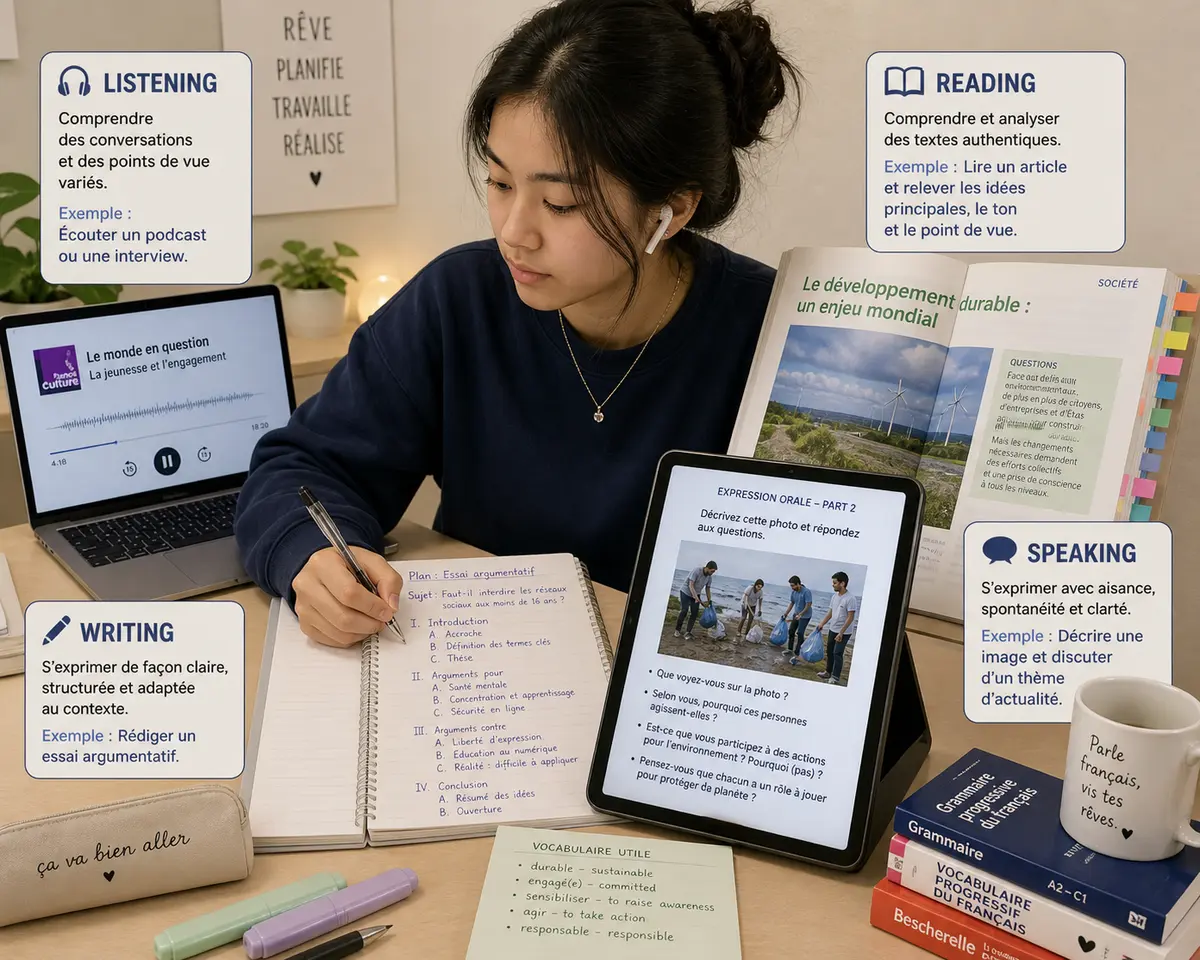
The IB French exam presupposes a transition from simple vocabulary memorisation to a sophisticated process of multilingual thinking and cultural analysis. It doesn’t focus purely on grammar and translation. Instead, the IB Diploma Programme language acquisition curriculum emphasises the ability to connect people and ideas through perspective and interaction. In this article, we’ll explain how to balance your revision across all four tested skills and achieve your best possible grade.
Understanding the 4 skills in IB French
Many students fall into the trap of over-focusing on written grammar exercises while neglecting the spontaneous skills required for real-world interaction.
Listening (compréhension orale)
This skill focuses on understanding context and meaning rather than perfect word-for-word translation. It involves interpreting a range of accents and speaking styles through various audio materials. IB French listening tasks test your ability to extract main ideas, identify specific details, and recognise speaker attitudes from recordings that reflect authentic French communication.
Reading (compréhension écrite)
It requires engaging with both literary and non-literary texts, such as novels, articles, and blogs. The goal is to develop interpretive skills and a deep understanding of idiomatic expressions and cultural nuances. Strong IB French reading comprehension means recognising how language choices convey tone, perspective, and cultural context beyond literal meaning.
Writing (expression écrite)
Written assessments demand the ability to produce logical, structured, and reflective texts. Students must adapt their tone and register to suit specific formats like essays, articles, or letters. For this part, students demonstrate grammatical accuracy, rich vocabulary, and clear argumentation while maintaining appropriate formality.
Speaking (expression orale)
The speaking component, particularly the Individual Oral (IO), evaluates a student’s ability to express opinions naturally and engage in spontaneous discussion. It tests both pronunciation accuracy and the depth of engagement with thematic topics. Here, students must be fluent, confident, and able to develop ideas without extensive preparation time.
Step 1 — how to improve listening skills effectively
In this and the following sections, we’ll explain how to train each of the skills assessed on your IB French. Let’s begin with listening. To sharpen your ear, engage with authentic French media, such as podcasts, news segments, and films. It’s recommended to listen daily, even if only for five minutes, and focus on capturing key words and the general gist. Gradually reducing reliance on subtitles when watching videos can further challenge your comprehension and simulate real-life auditory environments. Finally, try resources like “RFI Journal en français facile” for news at a manageable speed, or explore YouTube channels that discuss topics aligned with IB themes.
Step 2 — how to strengthen reading comprehension
Move beyond standard textbook extracts to authentic materials, including social media captions, short stories, and journalistic articles. Using annotated novels can help you learn unfamiliar words in context, which is more effective than memorising isolated lists. Maintaining a vocabulary journal allows you to track new terminology systematically and revisit it during your revision sessions.
Focus on reading strategies that mirror exam conditions: quickly identify main ideas, recognise the author’s perspective, and understand implied meanings. These IB French revision tips for reading can help you work more efficiently under time pressure during the actual exam.
Step 3 — how to improve writing for higher marks
The most effective way to improve IB French grade in writing is to focus on clarity and variety. Trying to impress the examiner with overly complex phrases won’t actually work. Instead, you should master the use of linking words and connectors to create a cohesive argument and logical flow. High-scoring work typically follows a clear structure, including a clear thesis and a prompt-focused conclusion within the word limit.
Practice different text types required by the IB French B syllabus: formal letters, blog entries, opinion pieces, and reviews. Each format has specific conventions for opening, developing arguments, and closing that you should master through repeated practice and feedback.
Step 4 — how to develop speaking confidence
Developing fluency requires you to speak aloud every day, even if you’re simply describing your daily routine to yourself in French. Recording yourself using voice messages can help you identify areas for improvement in pronunciation and intonation. To build the spontaneity required for the exam, practice responding to unseen visual stimuli or thematic prompts with a partner or tutor. Many students find that working with an experienced French IB tutor for oral practice provides the interactive feedback needed to build confidence and reduce hesitation.
How to combine all 4 skills in your revision plan
Preparing effectively for IB French requires a structured and strategic approach that balances all key language skills. Below, you’ll find some tips on practising all four skills within one study plan.
Creating a weekly balanced study schedule
First, you should establish a structured IB French study plan that allocates specific blocks of time for grammar, vocabulary, and each of the four exam components. Using a colour-coded calendar can help you visualise your progress and ensure that no single skill is being neglected.
For example, dedicate Monday to IB French listening practice, Tuesday to IB French reading, Wednesday to IB French writing exercises, and Thursday to IB French speaking drills. Fridays can focus on grammar and vocabulary.
Mixing passive and active learning techniques
It’s a good idea to combine passive immersion, such as listening to French music or podcasts while commuting, with active learning tasks like summarising those materials in a journal. Linking your vocabulary practice to the five core IB themes (Identités, Expériences, Ingéniosité humaine, Organisation sociale, Partage de la planète) ensures your learning remains relevant to the exam’s thematic expectations.
Using past papers strategically
Engaging with past exam papers is essential for IB French exam preparation because it familiarises you with question formats, marking criteria, and time pressure. You should analyse authentic question patterns to identify your strengths and weaknesses and target your revision more effectively.
When practising with past papers, simulate exam conditions by timing yourself and avoiding reference materials. Afterwards, review your work against the mark schemes to understand exactly what examiners reward.
Effective revision brings great IB French results
Mastering IB French is a cumulative process. Here, consistency matters more than cramming. Treat language learning as an exploration of how people express ideas across cultures in writing and speaking, and learn to understand these ideas through listening and reading. The IB French 4 skills method ensures you’re not just a student of the language, but a confident and capable communicator, whether you’re working on it independently or with expert guidance.
Comments
Comments are loaded when you choose to open them, which keeps the page faster and lighter.