Jadeite vs nephrite: which should you actually buy?
Two unrelated minerals share one English word, and most comparisons stop at the chemistry. The useful question is which one suits what you’re actually buying it for.
Jadeite and nephrite are both jade, in the sense that gemmology recognises exactly two minerals under that name and these are they. They are not related. Jadeite is a pyroxene, nephrite is an amphibole, they form under completely different geological conditions, and they behave differently in almost every way that matters to a buyer.
Most articles comparing them stop after that paragraph, which leaves the practical question unanswered. Here is the decision, dimension by dimension.
The one-line answer
If you want vivid colour and are prepared to pay for it, and to verify what you’re buying: jadeite.
If you want something to wear every day for the next forty years without thinking about it: nephrite.
That covers most cases. The reasoning is worth having, because the exceptions are real.
Durability: nephrite wins, and it isn’t close
This is the dimension most buyers don’t know about, and it’s the one that determines whether a piece survives daily wear.
Two separate properties are involved. Hardness is resistance to scratching; toughness is resistance to breaking. They are independent.
On hardness, jadeite is slightly ahead — roughly 6.5 to 7 on the Mohs scale against nephrite’s 6 to 6.5. Both are scratched by ordinary household dust, which contains quartz at 7. Neither has a meaningful advantage in practice.
On toughness, nephrite is the clear winner, and by a wide margin. Its crystals grow as densely matted interlocking fibres, so a propagating crack meets fibre boundaries at every turn, gets deflected, and loses energy. Jadeite’s crystals are interlocking grains, which works on the same principle but less effectively. Nephrite is routinely described as among the toughest natural materials used in jewellery — tougher than jadeite by a substantial factor.
The practical consequence: for a rigid bangle worn continuously, or anything that will take knocks, nephrite is materially more likely to survive. This is also why Neolithic Chinese carvers could work nephrite into forms that would have shattered in most stones, and why nephrite objects buried for four thousand years come out intact.
Buy nephrite if the piece is going to be worn every day, on a wrist, by someone who uses their hands.
Colour: jadeite can do things nephrite cannot
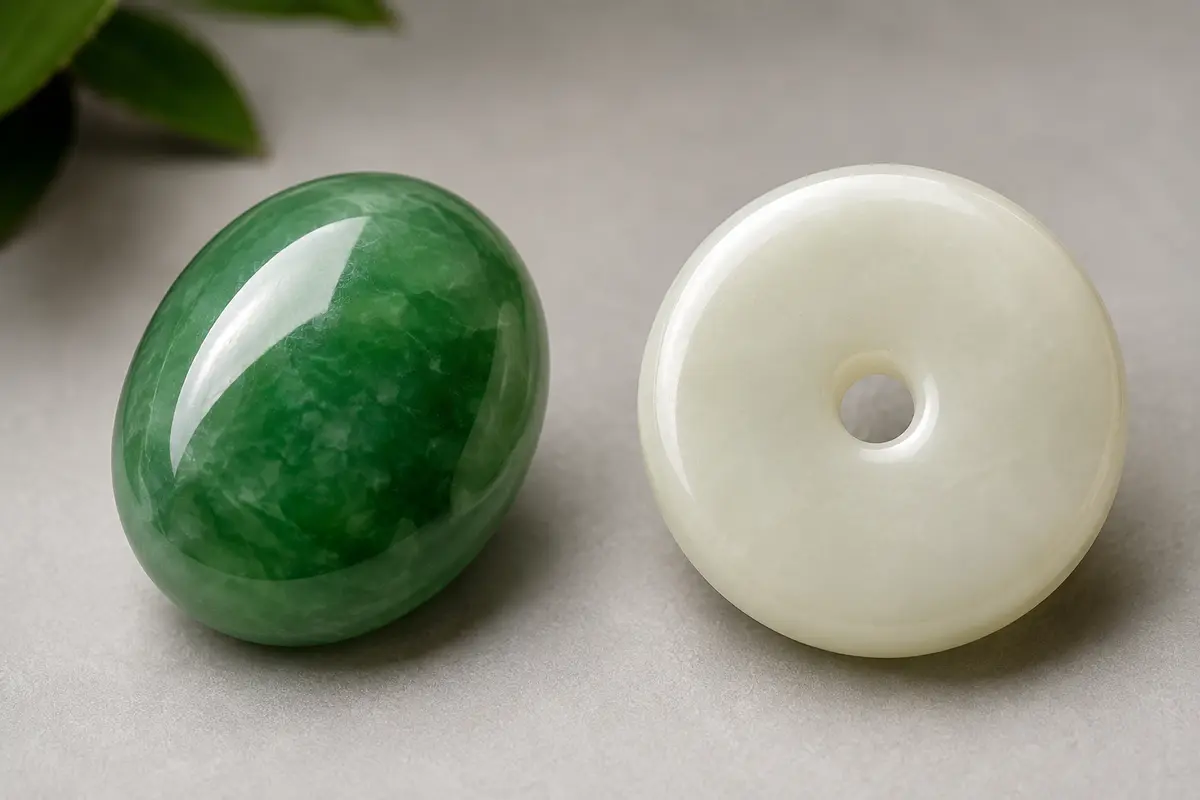
Jadeite covers a range nephrite simply doesn’t reach. Vivid emerald green, lavender, pale blue-green, and a near-black variety that transmits green under a torch. It also achieves much higher translucency — the property that makes fine jadeite look lit from within.
Nephrite runs from creamy white through pale and spinach green to grey and near black, with a softer, slightly oily lustre rather than a glassy one. It is quieter. Nephrite at its best is a warm, dense, semi-translucent white — the classical Chinese ideal — rather than anything vivid.
This is a genuine aesthetic fork rather than a quality ranking. The Chinese classical standard prized restraint: an even, quiet surface with nothing dramatic happening inside it. The modern market prizes saturation and translucency. Both traditions are internally coherent, and they want different stones.
Buy jadeite if colour and translucency are what draw you to jade in the first place.
Price: two completely separate markets
These are not one market with two grades. They are two markets that barely interact, and price comparisons across them are close to meaningless.
At the top, fine untreated jadeite with strong even colour and high translucency is among the most valuable gem material on earth. Nephrite does not compete there — with one exception, covered below.
At the entry and middle levels the relationship inverts. Good nephrite is considerably more affordable than good jadeite, because supply is far less constrained: nephrite deposits exist in Xinjiang, Russia, Qinghai, Korea, Canada and New Zealand, while commercial jadeite comes overwhelmingly from a single area of northern Myanmar.
The exception is hetian jade seed material — nephrite recovered from the riverbeds at Hetian in Xinjiang, tumbled and naturally selected over geological time so that flawed material broke apart before arriving. Genuine river-recovered seed stone is close to worked out and trades at prices that have more to do with collecting than with jewellery, comfortably above most jadeite.
So: nephrite is the better value proposition in the middle of the market, and can be the more expensive stone at the very top.
Treatment risk: nephrite is the safer purchase
This is the argument that should carry the most weight for an inexperienced buyer, and it rarely gets made.
A large proportion of commercial jadeite has been acid-bleached and impregnated with polymer resin — the trade’s Type B — to remove brown staining and raise transparency. The treatment transforms poor material into something that looks good, and the polymer degrades over years, yellowing and losing the transparency it created, with structural consequences as well as cosmetic ones. It is undetectable by eye, by touch, or by price. Only laboratory instrumentation settles it.
Nephrite is not immune to treatment — dyeing exists, and so does resin use — but bleaching and impregnation are far less prevalent, largely because nephrite’s economics don’t support it in the same way and its fibrous structure responds differently to acid.
The practical effect: buying jadeite without a laboratory report is a genuine gamble; buying nephrite without one is a much smaller risk. Neither should be bought unverified at a meaningful price, but the downside distribution is very different.
Buy nephrite if you’re new to jade, buying online, and not yet confident about verification.
Which forms suit which stone
The two minerals have ended up specialising, and it’s worth knowing which is conventional where.
Nephrite dominates carved figurative work, plaques, pierced discs, and pieces where the material’s toughness allows thin sections and undercutting. It is the traditional material of Chinese jade carving, and the vocabulary of motifs developed on it over thousands of years. Nephrite bangles are common and structurally sensible.
Jadeite dominates cabochons, bangles where colour is the selling point, bead strands, and anything where translucency does the work. It carries most of the modern high-end market.
There is also a gendered convention worth noting: black and dark green jadeite, and dark nephrite, are the conventional materials for men’s pieces, alongside plain undecorated forms in white nephrite.
Buying for a specific purpose
A gift, size unknown: either stone, but choose a pendant rather than a bangle. Nephrite if you want durability, jadeite if the recipient is drawn to colour.
A first jade purchase: nephrite. Lower treatment risk, better material for the money, more forgiving of inexperience.
Daily wear, active life: nephrite, for toughness.
Something to keep and pass on: either, provided it’s verified untreated. Untreated material of both species is chemically stable and does not degrade.
Investment-minded buying: this is the one case where jadeite is the answer, because that is where the top of the market is — and also the case where a laboratory report is non-negotiable rather than advisable.
Buying because you like a particular piece: buy the piece. The species matters for the reasons above, but neither is “better jade,” and a stone you find beautiful in the less prestigious species is a better purchase than a stone you don’t in the more prestigious one.
What to check either way
Whichever species, the same three questions do the work:
Which mineral is it? Stated explicitly on the listing — “jade” alone is not an answer, and the word covers a much wider range of stones in common usage than the two gemmological species. A broader guide to the types of Chinese jade in circulation covers the serpentines, quartzites and feldspars that also travel under the name.
Has it been treated? In writing, with the classification stated — not implied by the word “natural,” which is compatible with heavy treatment.
Can the report be verified? A serial number checkable on the issuing laboratory’s own website, reached by typing the address yourself.
Answer those three and the jadeite-versus-nephrite question becomes what it should be: a choice between two different stones with different characters, rather than a gamble on what you’re actually holding.
Comments
Comments are loaded when you choose to open them, which keeps the page faster and lighter.