



Audacity
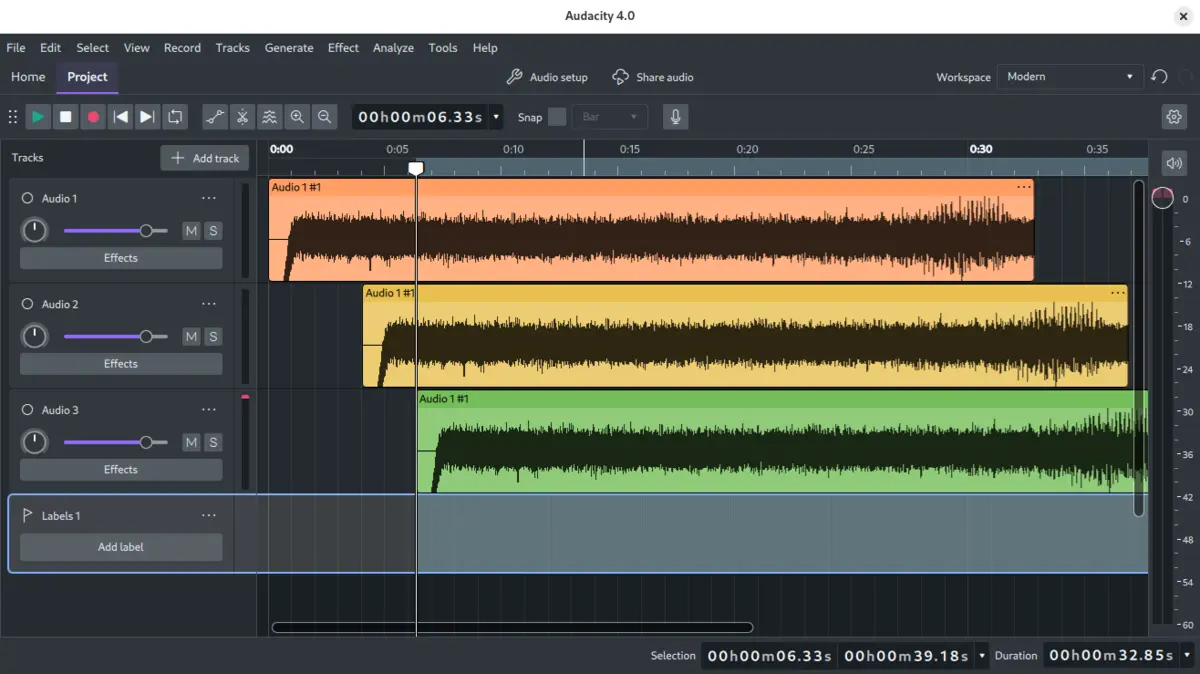
Free and open source multi-track audio editor and recorder
Is Audacity open source?
Yes. Audacity is open source software released under the GPL-3.0-or-later license and developed by Muse Group and the Audacity team. The source code is public in its official repository.
Advertisement
Overview
Audacity was started in 1999 by Dominic Mazzoni and Roger Dannenberg at Carnegie Mellon University as an academic project for audio analysis research, and was released as free software soon after. It has since become one of the most widely used cross-platform audio editors, with a large plugin ecosystem and support for the majority of common audio formats through the bundled FFmpeg and LAME libraries.
Development has continued under a series of maintainers, most recently the Audacity team backed by Muse Group, which acquired the trademark and led development from 2021 onward. A community fork, Tenacity, emerged during this period in response to concerns over proposed telemetry and licensing changes; Audacity itself remains licensed under the GPL and has continued regular releases.
Key Features
- Multi-track recording and editing — Record from multiple inputs and edit an unlimited number of tracks
- Noise reduction and restoration — Built-in noise reduction, click removal, and other cleanup effects
- Spectrogram view — Visual frequency analysis for identifying and isolating specific sounds
- Wide format support — Import and export WAV, MP3, FLAC, OGG, and other formats via bundled codec libraries
- Plugin support — Compatible with LADSPA, LV2, VST3, and Audio Unit (macOS) effect plugins
- Macros and batch processing — Automate repeated editing tasks across multiple files
Use Cases
- Podcast and voiceover editing — Recording, cleaning up, and trimming spoken-word audio
- Music editing and mixing — Basic multi-track recording and mixing for musicians and hobbyists
- Audio restoration — Removing hiss, hum, and clicks from old recordings or digitized tapes/vinyl
- Format conversion — Converting between common audio formats using the built-in export options
Who It’s For
Audacity is the default starting point for anyone who needs a free, cross-platform audio editor without a learning curve as steep as a full DAW — students, podcasters, and hobbyist musicians in particular. Its long history and large user base mean extensive documentation and community plugins are readily available for most common editing tasks.
Advertisement
Similar software: Audio Editing

Ardour
Professional open source digital audio workstation
Ardour is an open source digital audio workstation for recording, editing, and mixing audio and MIDI, aimed at professional and semi-professional studio work.

LMMS
Free and open source music production and beat-making software
LMMS is a free, open source digital audio workstation for beat-making, synthesis, and loop-based production, with built-in instruments and effects.

Qtractor
Linux-native open source multitrack audio and MIDI editor
Qtractor is a free, open source multitrack audio and MIDI editor for Linux, built on the JACK Audio Connection Kit and ALSA sequencer.

Tenacity
Privacy-focused, community-maintained fork of Audacity
Tenacity is a community-maintained, privacy-focused fork of Audacity, created in response to proposed telemetry and licensing changes in Audacity's development.

Adobe Audition
Proprietary digital audio workstation from Adobe
Adobe Audition is a proprietary digital audio workstation for recording, editing, mixing, and restoring audio, sold through Adobe's Creative Cloud subscription.