Debian 13.5 Released: 103 Security Fixes and 144 Bug Corrections
The Debian Project has released Debian 13.5, the fifth point release of Debian 13 “Trixie”. Released on May 16, 2026, this update consolidates security patches and bug corrections accumulated since the previous point release.
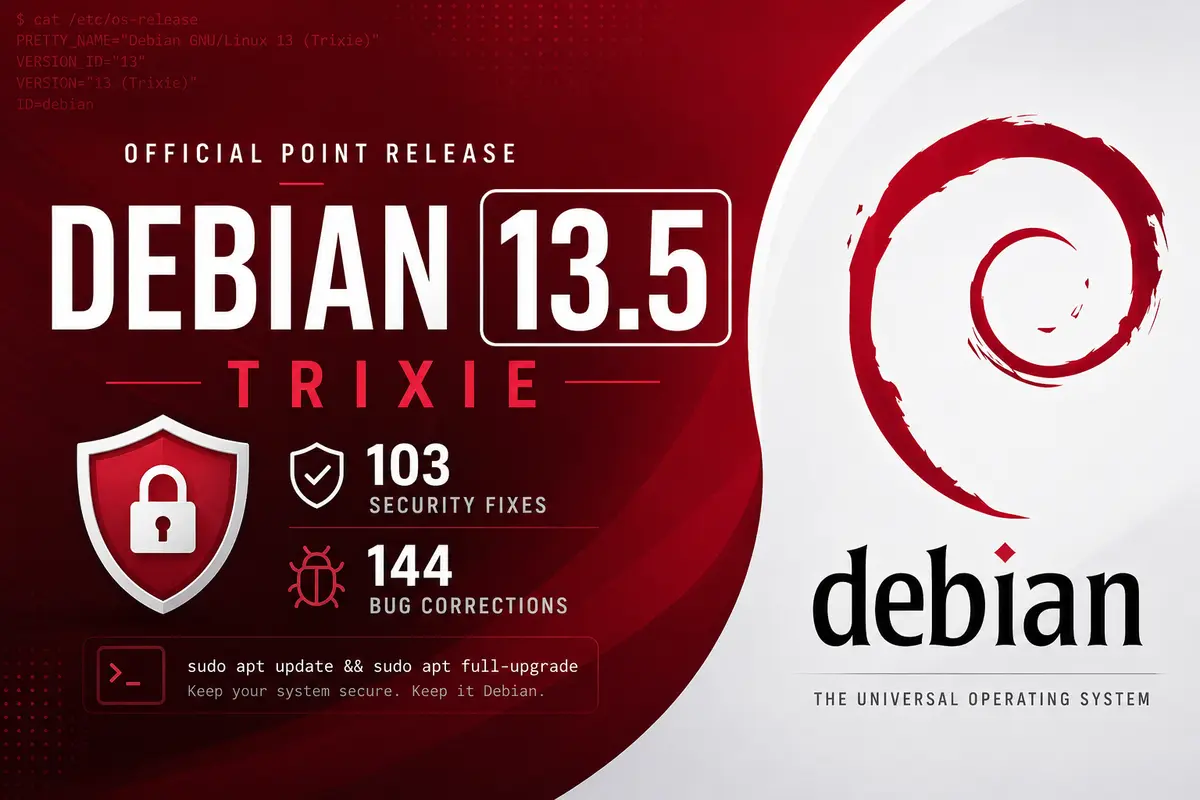
Debian 13.5 is a point release, not a new version. It brings no new features. Instead, it rolls up fixes released individually over the past months, giving users clean installation media without needing a long post-install update run.
As the Debian Project notes in its official release announcement, users who already update regularly from security.debian.org will find most of these fixes already applied.
What’s Fixed in Debian 13.5
In total, Debian 13.5 includes 103 security advisories and 144 miscellaneous bug corrections.
Some of the more significant fixes include:
- glibc — Addresses incorrect DNS response handling, invalid hostname returns, and an assertion failure.
- systemd — Updated to a new upstream stable release (257.13), with fixes for code execution flaws and an nspawn escape-to-host vulnerability.
- OpenSSH — Multiple fixes including a case where
scpcould unexpectedly mark transferred files as setuid/setgid, and a command execution flaw. - Apache — Covers use-after-free, privilege escalation, NULL pointer dereference, and HTTP response splitting vulnerabilities.
- bubblewrap — Patches a privilege escalation issue (CVE-2026-41163).
- nano — Fixes an overly broad permissions issue (CVE-2026-6842).
- sudo — Patches a privilege escalation flaw (CVE-2026-35535).
- X.Org Server — Buffer re-use, out-of-bounds read, and use-after-free issues addressed.
- Python 3.13 — Multiple header injection, denial of service, and validation bypass fixes.
The update also improves compatibility with Python 3.13 across several packages, and corrects an illegal instruction issue on RISC-V 64-bit in GRUB EFI code.
Desktop Environments in Live Images
Fresh installation images for Debian 13.5 are available for the amd64, arm64, armhf, ppc64el, riscv64, and s390x architectures. Live images ship with several desktop options: GNOME 48, KDE Plasma 6.3.6, Xfce 4.20, Cinnamon 6.4.10, LXQt 2.1, MATE 1.26.1, and LXDE.
If you want a full picture of what changed when Trixie first arrived, the Debian 13 Trixie release post on OpenSourceFeed is a good starting point.
How to Upgrade
Existing Trixie users do not need to reinstall. Simply run:
sudo apt update && sudo apt full-upgrade
Point the package manager at any Debian HTTP mirror. A full list of mirrors is at debian.org/mirror/list.
Alongside Debian 13.5, the project also released Debian 12.14 as an updated point release for the older “Bookworm” series, carrying 145 security fixes and 99 bug corrections.
For the complete list of changed packages, see the Trixie ChangeLog.