Why teams are moving to structured AI systems
In the early days of the generative AI craze, there seemed to be an assumption that anyone capable of writing a smart paragraph could turn it into a fully functional application. For months we have been fine-tuning our adjectives, instructing the systems differently, and begging the models to “take a deep breath” before performing any difficult math calculations. It was magic! However, once companies started trying to scale these playgrounds to real enterprise-level applications, they ran up against limitations pretty fast. And the truth was very clear: one prompt is just too fragile, unstable, and limited for business logic.
The world is experiencing a big paradigm shift right now. Engineering squads stopped thinking about LLMs as black box, all-wise oracles. Instead, they are turning them into building blocks of deterministic software architectures. They don’t expect a single prompt to do everything anymore.
Defining the shift: what is a structured AI system?
As for the current way in which modern teams develop production software, there is a definite shift towards modularity. When you consider the definition of a traditional AI agent definition, you realize that it is not a single model that answers the questions but rather a software that perceives the environment, makes decisions and acts upon those decisions with the help of some external means. In the case of a well-designed system, we would not rely on one large, unstructured prompt to carry out the whole process.
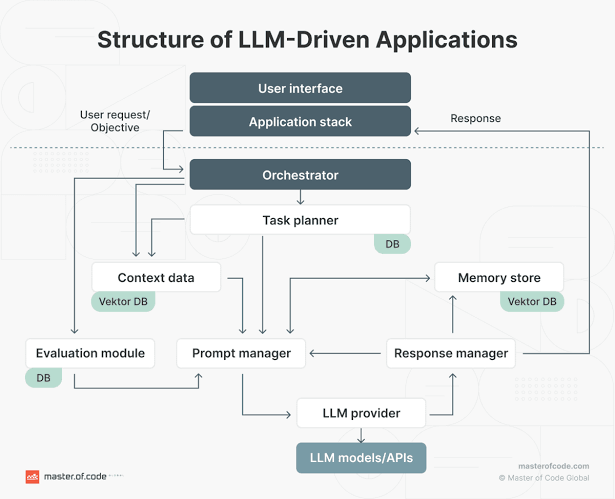
To make this shift successful, teams rely on orchestration frameworks like LangChain and LlamaIndex to build reliable pathways. These frameworks allow developers to chain prompts, inject dynamic context from vector databases, and implement hardcoded fallback routes when the model output is unexpected. By turning a single, open-ended conversation into an explicit state machine, developers gain control over the system’s execution flow. If you are exploring open-source AI tools for Linux environments, many of these frameworks run well locally alongside tools like Ollama and LocalAI.
Why single prompts fail in production
Relying on a single prompt for complex workflows is the software engineering equivalent of writing your entire application inside a single, giant main() function. It might work for a basic demo, but it collapses under the weight of real-world edge cases.
Question: Why can’t we just write highly detailed, 1,000-word prompts to handle all exceptions?
Answer: Because LLMs suffer from “lost in the middle” phenomena, attention dilution, and non-determinism. When you pack instructions, edge-case handling, and contextual data into one massive prompt, the model is highly likely to ignore crucial constraints. Furthermore, debugging a giant prompt is incredibly difficult. If the output is wrong, is it because of the system prompt, the user input, the few-shot examples, or simply a random temperature variance? In contrast, structured systems isolate these variables, making errors easy to track, test, and resolve.
Additionally, unstructured prompts lack robust memory management. Enterprise applications often require tracking conversation state, transactional histories, and external system states across days or weeks. Without structured database integrations and explicit state graphs, relying on the raw context window quickly becomes cost-prohibitive and technically unviable.
The architecture of modern agentic systems
In developing systems which can carry out actions successfully, there are plans to develop a multi-agent system where each agent will be designed to perform certain sub-tasks. One agent will be tasked with transforming user requests to queries in the database, while another will be tasked with assessing the results’ safety.
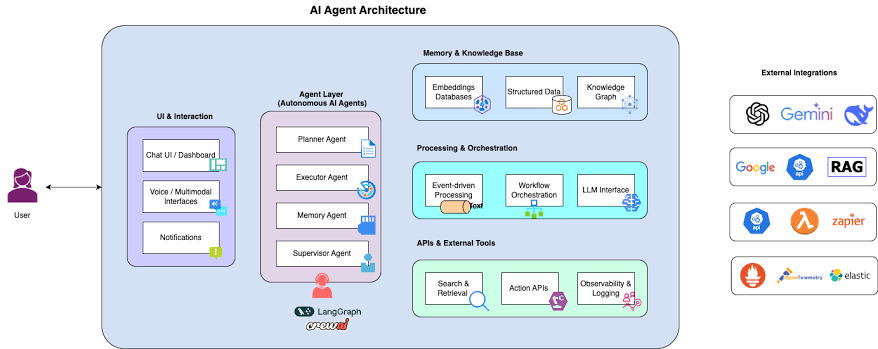 Multi-agent architecture with specialized task divisions. Source: GoPenAI
By splitting these responsibilities, each model can run on a smaller, faster, and cheaper LLM fine-tuned for that specific job. For example, a team might use an ultra-fast, cheap model to classify routing logic, and only invoke a heavy, reasoning-focused model like those on the OpenAI Developer Platform when deep cognitive processing is required.
The table below contrasts the stark differences between legacy, prompt-heavy setups and modern structured AI systems:
| Capability | Legacy Basic Prompting | Modern Structured AI Systems |
|---|---|---|
| Execution Control | Linear, unpredictable text generation | State-machine based routing and conditional flows |
| Tool Integration | Hardcoded text parsers attempting to extract API parameters | Native Tool Calling (JSON schemas) with automatic validation |
| Memory | Shoving the entire chat history back into the context window | Multi-tier storage (short-term Redis, long-term vector/graph databases) |
| Testing & Eval | Manual “vibe checks” by developers reading sample responses | Programmatic assertion tests using frameworks like promptfoo or DeepEval |
| Cost & Latency | High (processing giant, repetitive system prompts every run) | Low (routed queries running on optimized, specialized models) |
Real-world implementation: how teams build reliability
Transitioning to structured systems requires adopting software engineering principles that have governed traditional development for decades. Developers are now utilizing robust developer tools like Microsoft Semantic Kernel to treat prompts as compiled code rather than loose scripts. For teams wondering which operating system best supports this kind of AI development work, our guide on the best Linux distro for AI development covers the key options.
When building these systems, teams focus on three core areas:
-
Deterministic Guardrails: Every time a model outputs a response, structured parser layers (like Pydantic) validate the format. If the format is incorrect, then the error gets returned back to the model within the context of a structured loop for self-correction.
-
Evaluations (Evals): Instead of relying on manual review of a subjective nature, teams perform CI pipelines that constantly evaluate model output in dozens of scenarios in terms of its accuracy, drift, and toxicity.
-
Semantic Caching: In order to save on expenses and reduce latency, the system tries to find out whether there is a similar query among database caches before even sending a token to an LLM API.
Conclusion
The time has come when prompt engineering will not serve as a magic solution anymore to solve software-related issues. Even though a good prompt is great for prototyping and testing ideas, scaling up AI into an enterprise-ready solution would require the structure and discipline of classic software development. The development of modular and deterministic systems that use LLMs as calculating machines rather than coordination engines helps attain the needed predictability, scalability, and efficiency. In the end, the industry’s vision of what a functional AI agent is has shifted: it is no longer a simple chatbot with API access; it is a well-coordinated system.
Comments
Comments are loaded when you choose to open them, which keeps the page faster and lighter.